College – Is Bad? Not In My Life

I owe my position in life to my college studies. I made it through 5 semesters of calculus, 3 semesters of physics, 7 semesters of chemistry, and eventually an entire buffet of technical courses applying to my major of chemical engineering. I learned about statics and dynamics. I learned about electrical engineering principles. I had fundamental computer skills which were taxed in later years as my profession underwent computerization. With a diploma in hand, I was able to take out my books and learn all about statistics when my job required that knowledge. Would I have learned these skills if I bypassed college and went directly into the workforce? Probably not.

I had a smattering of non-technical courses. Always I had a performing vocal course, as it served as a way for me to keep my sanity and help to balance out the sexual imbalance present in my technical courses – virtually no women in those classes. Even there, in my electives, I chose difficult classes. How many folks would take Music Theory for Non-majors as an easy class? Likewise, how many folks would take Biochemistry for the fun of it? Face it, I had an unusual thirst for knowledge, and college was the place for me to expand my knowledge and provide me the skills I would need for my entire career. Which is one reason why I have difficulty in understanding the bad-mouthing being given to college by so many in today’s world. Yes, I do understand that relatively few have the thirst for knowledge I possess. I also understand that relatively few have the tenacity to put themselves out and finish classes requiring such explicit technical knowledge.

I am not able to make a judgement about whether we are graduating too many lawyers, when we have so many problems where lawyers slow down implementing solutions, instead of facilitating them. I cannot say that “soft” skills are inferior to the hard sciences I was exposed to. I have good reason to understand that “soft” skills have great value in this world. I married a woman who was motivated enough to survive a double major in college (in 2 “soft” skill subjects), and then put herself through 2 master’s programs. I have to refer to her as master, master, in recognition that her creditable skills are greater than my own pile of BS. But somehow, over the nearly 50 years since I completed my field of study, it has been decreed that college is “not worth it’.

How did that happen? In part, because colleges and universities began a competition. They were participants in the huge meritocracy experiment we conducted upon ourselves. Annual surveys were made of the “best’ schools, and much of the inflation of costs for college came about as college administrators fought to keep themselves relevant in this age of competition. These fights even reached down to state schools, where not only were amenities deemed essential, but support from states diminished over the decades. Now you had to determine whether the NROI of a college was worth it. Whereas I was able to attend at a cost of $16 per credit hour, those costs now are in the hundreds of dollars per credit hour at state schools, and literally thousands of dollars per credit hour at the peak of the school meritocracy list.

I know my college had a huge NROI for my expenditures. Yes, I could work a minimum wage job on a very part-time basis, and end up paying for my expenses and leaving enough for pizza and beer. On the college campus, we only had those in fraternities and sororities who were able to lord it over the poor students living in un-air-conditioned dorms. Somehow, I didn’t encounter very many of those folks in my science and engineering classes. The class distinction existing outside of college was perpetuated by these Greek houses.

Now, looking back, it is obvious to me that my choice of majors greatly influenced my earning power. Employers did want those who had technical skills (and if you were literate and could string sentences together coherently, so much the better). I was a beneficiary of the value society placed upon technical skills. What is abundantly clear is that too many of today’s graduates are not valued adequately for the benefits they provide to society. First among the list of the undervalued are teachers. It takes a special set of skills to enable someone to convey their own love of learning to a new generation who actively disdains schooling. And if we want a new generation to continue the path to prosperity we find ourselves on, then it is obvious teaching is a vital skill for society. Yet too many teachers find themselves locked out of living in the districts they teach in due to their own paltry pay. Somehow we must find a solution which enables teachers (and other civic servants) to live in the neighborhoods they serve.

How do we get out of this endless treadmill of escalating costs but insufficient remuneration for jobs unlocked by education? It does require a revisionist approach to the issue of what should college do? First, it must keep the supply of technically-educated people alive and growing. We bask in the fruits of technology (food supply security, incredible technology for communication, medical miracles in imaging and pharmaceuticals), but we do not provide enough recompense for those who study in the fields which make it possible to grow new fruits. Second, we believe in the moral superiority of those who create jobs. Thus it would seem a greater emphasis on economics and entrepreneurism would benefit all of society. But even more, we need a renewed emphasis on those who can maintain the infrastructure we have created for ourselves.

Back when I was growing up, you could find shade tree mechanics who could diagnose and fix problems in cars. Now? It is nigh unto impossible to even begin to understand the highly computerized systems making up today’s cars. I remember needing to stay current on things like oil levels in a car, since you could anticipate problems by just understanding baseline performance. The other day I had to pop the hood on a car we’ve had for seven years. It took forever to figure out how to raise the hood. We just do not need to look there as much as we used to. We’ve been spoiled by the improved reliability from auto manufacturers. But as we have seen, it takes much more technical knowledge to enable someone to understand cars and fix their inevitable problems. There should be a place where these skills are taught, serving the public by improving the human infrastructure. A combination of community college and college/university courses can give someone the knowledge and skills not only to directly fix problems, but to eventually build their own business in auto repair. We do see some of that driven by businesses, trying to generate the knowledgeable employees businesses need. There is a need for people to learn these skills, and it keeps growing as our systems we depend upon grow ever more complex.

Unfortunately, that is not what our college and universities seem to want to provide. At some point, we need to move beyond ivy-covered walls and do a deep dive on how to use college to meet all of our needs as a society, without creating massive debt as a primary product.
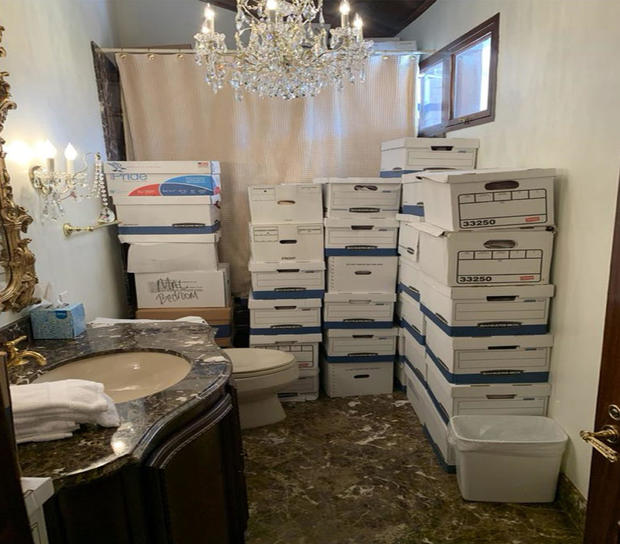

So. Many. Boxes

Photo from Justice Department

Hundreds of docs. Thousands of docs. Millions and billions and trillions of docs. Like many others, I had a mental image of the documents in question stored at the Mar-A-Lago resort. That image did not include a stage filled with boxes, a bathroom where the reading of choice could have included nuclear secrets, a wall filled with banker’s boxes of documents. The sheer scale of the illegally retained documents forced an unanticipated gasp from my throat. Of course, there are millions of people who will deny the evidence presented to them, and who defend the indefensible.

By this time, it is apparent it is impossible to shame any of Trump’s defenders. What we have here is the divine right of kings personified in a hugely unfit blob of protoplasm. If you look at Donald Trump through the veil of royal prerogative, his actions become much more understandable. He has been accorded the divine right, thus he is incapable of doing anything wrong. All of the moralists of all time have it wrong regarding Trump’s actions. You cannot hold him accountable for any of his actions because he was forgiven by the divine right he possesses. Thus it is not a problem for him to have pontificated for better controls for classified materials in 2016, and then claim total and complete innocence when his own issues dealing with classified materials were revealed in 2022-23. Then the victims of Trump Derangement Syndrome go on the offense, defending the man’s actions since it is clearly evident he could never do wrong.

No, what is evident to those of us outside of the Trump cult is the complete idiocy of his positions, and those who support him. What one must keep in mind is this quote from Charles MacKay: “Men, it has been well said, think in herds; it will be seen that they go mad in herds, while they only recover their senses slowly, one by one.” There will never be a single event which will cause the true believers to abandon the object of their affection. All you can ever hope for is that you have a slow and steady erosion of his support as the steady drip, drip, drip of his wrongdoing keeps getting exposed.

I’ve read the 49-page indictment. It is abundantly clear that the object of Trump’s obsession with his documents was a misguided belief they belonged to him, and him alone. Never mind his insistence on deceiving his own attorneys into swearing to his veracity when saying he had turned over everything of interest. How could he be held accountable for retaining items post-presidency when he never actually entered post-presidency. After all, he won the election, didn’t he? It’s not his fault that the reality-based view of everyone outside of his cult is that no, he actually lost the election. He’s been totally consistent in his insistence that the election was stolen from him.

The problem is now he is dealing with those who are mentally disturbed who still belong to his cult. And many of these (as Kari Lake points out) believe in second amendment solutions. That is, over and over, those who believe violence is justified are simply awaiting their opportunity to demonstrate loyalty to their fearless leader by committing some act of violence with their plethora of second amendment weaponry. In their warped minds, anyone who dares to express any statement of disloyalty is just asking to be upbraided with a 9 mm solution. If they can take out a transgender supporter at the same time, so much the better. In other words, the entire political discussion has now become more than toxic. It has become dangerous to the vast majority of the nation, since it is only a relatively small minority who still believes in Trumpal infallibility.

I for one am sick of this charlatan who has hijacked the national discussion. There are so many real issues we need to deal with, yet we keep getting stuck on discussing this toddler who commands the loyalty of so many who are brain dead. Sooner or later, they will discover it was never about them. It was always what can we do for Donald? How can we give him the honors and fealty due him? If we give him what he wants, then everything will be all right, because of course, his magnificence will solve all problems we have. We just need to return The Donald to the seat of power and all will be right with the world. Gahh!

More Useless Pandering (From Both Sides)

Corn ethanol plant – image from Google Earth

Let the pandering begin. Since this is the summer before the totally useless and unrepresentative Iowa caucuses, we get to see politicians from both parties extolling the benefits of using corn-based ethanol in gasoline. Since we gained a legislative mandate to use ethanol beginning back in the 1970’s when it was pitched as a way of growing our own energy, this mandate has become the truly untouchable political position, even though it causes much more harm than good.

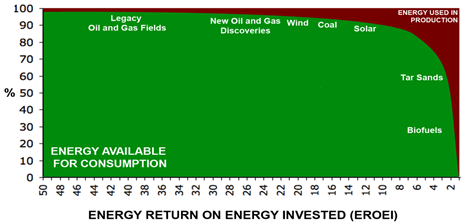
Ethanol from corn has been pitched as a way for the US to become less dependent upon foreign sources of petroleum. It still is argued that it is good for the US, since almost all studies show a net positive gain in energy production. But let’s look at corn ethanol in more detail. The studies that are available date back to the early days of this century. They show corn ethanol to be slightly positive in terms of energy made available per unit of energy input. For corn, this would include fertilizer energy, tractor diesel fuel, and energy used in extracting corn sugars which are made into ethanol. Here is a chart that shows the energy balance for most of the common sources of energy:

As can be seen, biofuels are on the far right hand side of this chart. Data from industry sources indicate that the energy balance has increased to 3-4 times as much energy produced compared to input energy for many facilities. This is to be expected as the corn ethanol industry becomes mature and has incremental improvements. But let me say that even at the high point of industry surveys, corn ethanol is a poor source of pure energy. A lot of inputs must go into ethanol from corn in order to gain the available energy.

First, please note that about 60% of Iowa’s corn goes into ethanol production. That means that the Iowa farmer, popularized by Grant Wood in his American Gothic painting, must continue to grow corn at a high rate in order to satisfy industries need to comply with the ethanol legislation. That legislation calls for 36 billion gallons of bio-based ethanol to be produced and blended with virgin gasoline. So what are the non-energy impacts of this amount of corn production? It would seem that this corn production is a significant contributor to the dead zone in the Gulf of Mexico as excess nutrients and soil flow down the Mississippi River to mingle with the Gulf waters. This dead zone keeps increasing in size, and by 2021 totaled over 6,000 square miles where the excess nutrients enabled blooms of algae. These blooms deplete the oxygen in the water, creating this dead zone where no other marine life can exist. All because what began as an effort to replace imported oil, has become an essential backstop for the farm economy. And nowhere is that more clear than in Iowa.

So politicians all pay homage to what is now the status quo, where overproduction of corn to satisfy legislated mandates are sacred. Since Iowa still maintains an outsize influence on the political discourse of the nation, no one who wishes to grab the brass ring of the US Presidency dares to question the advisability of using US corn to create a gasoline extender. We will see homage paid to the hard working farmer, and the discussion will be framed so that every gallon of ethanol produced displaces a gallon of oil imported from our enemies. Who could be against that?

Oh, wait a second. What happens with the electrification of the transportation sector? If more and more vehicles are electric, will politicians adjust the requirements downward to reflect lower gasoline production? Yeah, what planet do you reside upon? You expect politicians to reflect reality in their expounding? Or do you expect a continuation of what is now a well-established status quo, with political influence overcoming reality?

I will be watching the discussion this summer as the politicians pledge their fealty to maintain this ethanol mandate. If any politician dares to address the issue, and call for reduced ethanol production, I would be amazed (and would consider that politician for my vote). But I do not expect anyone to make a politically unpopular proposal in the most agricultural of all states, Iowa.

Before I leave the topic, there is one good thing ethanol blending has caused. Since ethanol is a good solvent for water, the issue of gas line freezing in winter has vanished. If you do not have a separate water phase, you will never freeze the lines, and this has reduced the advantages certain gasolines had in preventing gas line freezing.