Summer Reveries

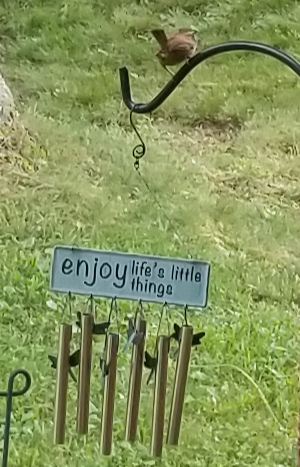
You can always tell it is full summer when the hummer wars begin. We hang out two feeders, and early in the summer, there is no competition for the feeders. But at some point, a male hummer takes possession of the feeders, and chases off any interloper.eH That is the line of demarcation between low and high summer. The sound track of high summer consists of the shrill calls of the katydid, along with the pulsating sounds of the cicadas. Weeds even grow dormant as the relentless heat bakes us during this drought we find ourselves in. Leaves on the trees were impressively green despite the lack of moisture, but now the leaves are tinged more often in shades of yellow and brown and the ground is littered with the shriveled hulks of the losers in the moisture war. So last week, we got over 2 1/2” of rain at one time that was not forecast. It probably will be too little too late for anything other than the weeds.
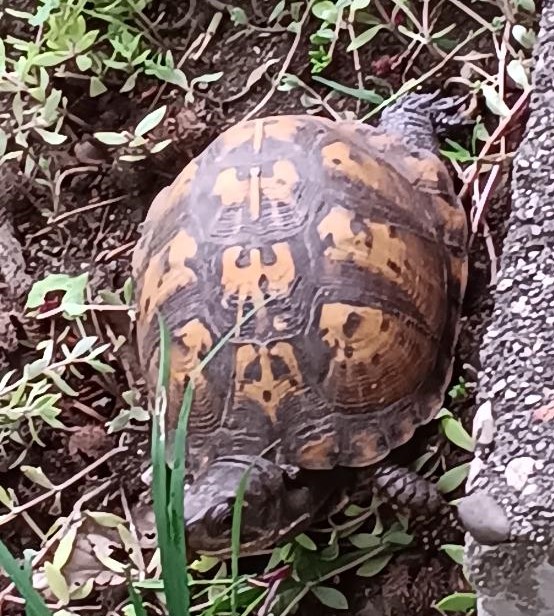
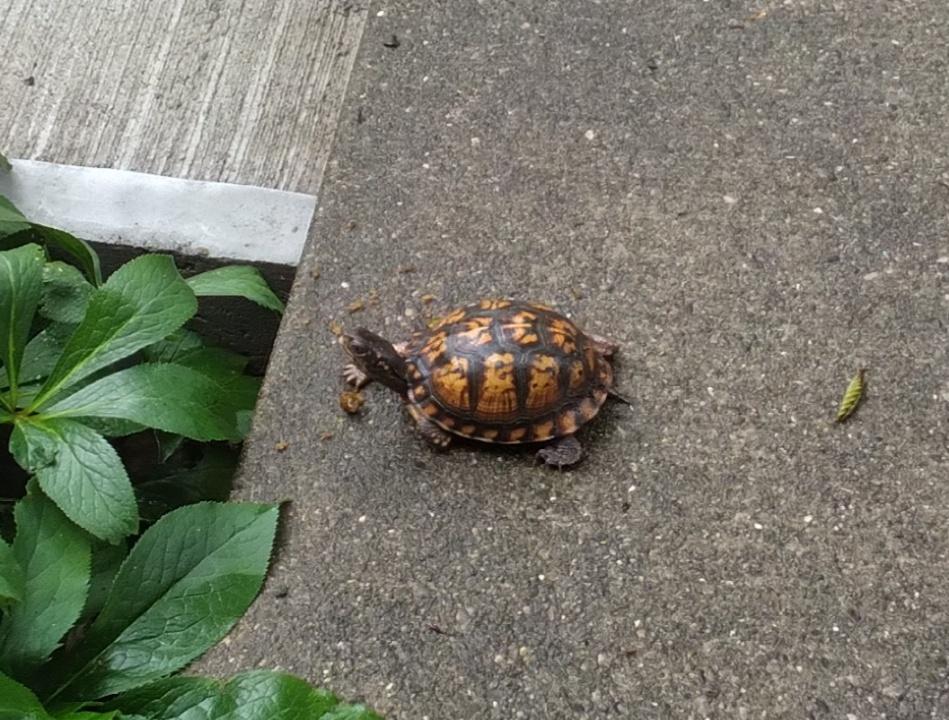
It is time to take stock of the other species who share our land. I see the neon-blue skinks as they skitter across our small retaining wall while I weed. Once I saw the box turtle who lives on our hillside, coming down our front slope. It must have survived the existential journey across our street, since even on our quiet street, we average 3 vehicles per minute. I wonder how I must have appeared to the turtle, who was looking up at this horrendously large being, trying to determine whether it would be worthwhile to pull head and legs inside of the protective shell. I left the box turtle to explore on its own, and went back inside. I saw it cross our steps, but then it disappeared. I’m just glad to see it back for another year. I do remember one year when I saw turtles mating in the back yard. It is tough not to anthropomorphize when you see them slowly turn their heads toward you, as if to say, “Hey! How about a little privacy here.”

We can never go far away from our largest visitors – the deer. Each year we see the new generation grace our yard. This one was particularly noisy as the fawn nursed on our driveway. There are two fawns that like to lay down in our back yard. No pictures of them dining from their mother. Soon the fawn’s spots will fade, and they will take on the behavior of their parents. By this time next year, we may swear at them if they forage in our flowers or our garden. But at this age, their cuteness wins them a bit of a reprieve.

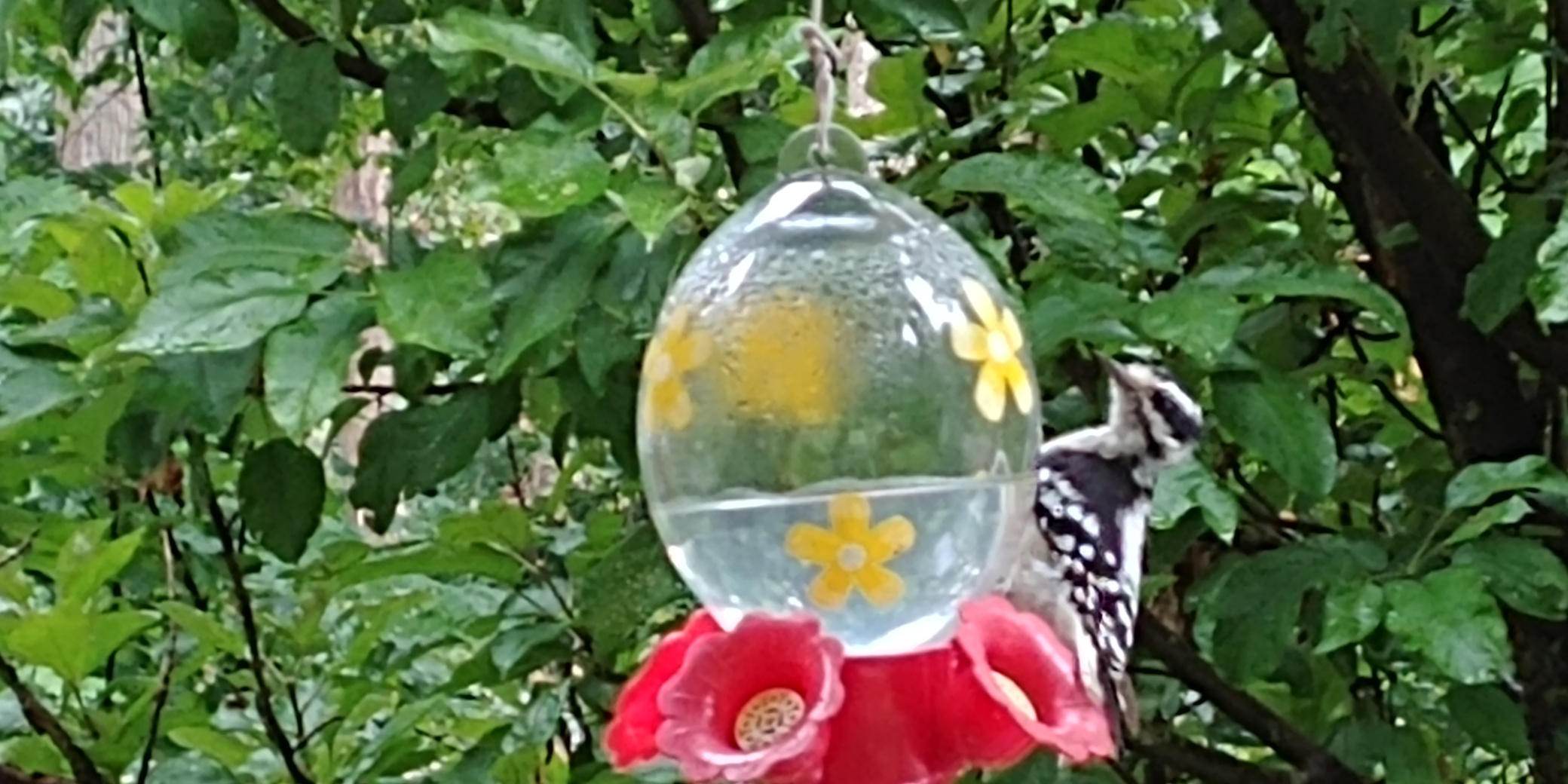
There are some visitors to our hummingbird feeders that do not elicit a territorial response. The flickers sneak up on the feeder, first trying out our cherry tree in the yard, then flying over to the palm we keep in our summer living room, and only then selecting the feeder as their ultimate destination – unless they notice us, in which case they are likely to fly away. They are ten times larger than the hummers, so it is not a direct competition between the two species. Then the red-headed woodpecker announces its presence by drilling our soffit. Soon our feeder is overwhelmed by the size of the latest visitor. I’m still waiting for the arrival of our pileated woodpecker, who dwarfs all other birds at our feeder. You can hear their call in our woods, so we know they are around. Every so often we see one partaking at the suet feeder when we hang it in winter, so we know they are familiar with our porch.

I survey our garden slopes at this time to find bulbs that have broken through the surface. If you work at it, weeding will uncover several clumps of daffodils and jonquils to distribute to others. It is amazing how a few bulbs can engender much good will when they emerge next spring in bloom. Daffodils from our yard are now growing in multiple states, and this year maybe in a few more.
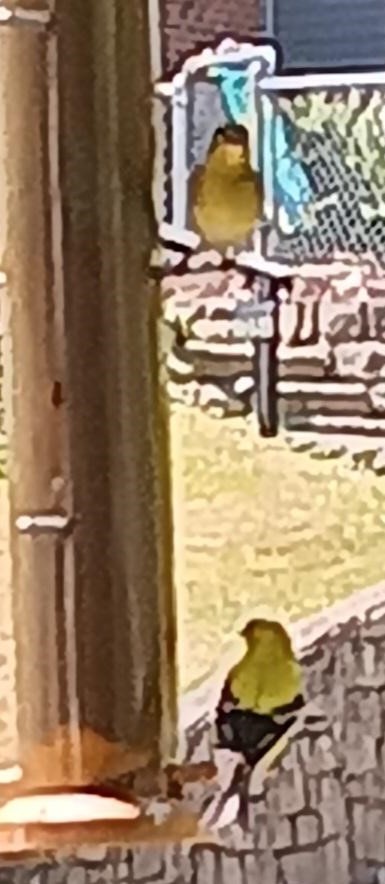
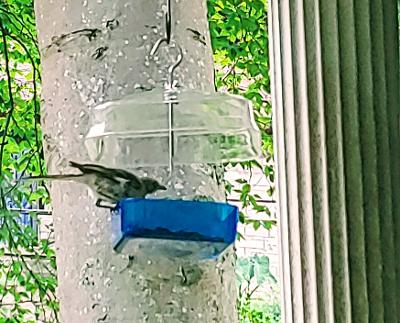
This year our finch feeder is attracting more chickadees than finches. But if you are patient, you may catch a finch seeking a nyjer seed fill. At least, this year no cowbird young are being fed by finch parents, as I’ve seen in the past. Cowbird bills won’t fit in the holes for smaller birds, so I’ve seen adoptive parent birds feeding young birds that should have fledged, but are still hanging around their smaller adult “parents”. I’ve wondered how a cowbird learns its life skills when they are raised by other species, but I won’t live long enough to get that answer.

Summer is a time to unplug and unwind. Even though we are retired, we have a hiatus from choir, chorus, and symphony rehearsals. The sport of summer, baseball, invites you into its slower rhythm, at least as compared to other sports. The drama of a pitcher/hitter confrontation plays out over minutes, while other sports whiz by in a blur of athleticism. That is why baseball is so good for summer, since it seems in synch with the slower pace of life. Soon we will see leaves fall for good, and the chillier air fits in with the faster paces of football and hockey. But baseball has a way of drawing you into believing that this is your year, only to dash that hope on the rocks of a poor bullpen. Oh, well, there’s always next year.

Observations of the Summer

Every once in a while, it is instructive to bring back one of the statements of one of our greatest philosophers. Yogi Berra once said, “You can observe a lot by just watching”. That is a true statement, but it requires you to take the time to really observe. Nowadays with the ubiquity of cell phones, people wish to live in their virtual worlds instead of the actual world they live within. The insect shown in the photo above is something that only becomes apparent if you truly observe. We were drinking coffee on our front porch when Carrie said, “What is that on the wall? A bug or a dead leaf?”

We quickly checked our sources. Carrie put it on Facebook, and within about 10 minutes she had an answer. Meanwhile, I googled insect identification sites, and had an answer shortly that matched the answer we received in Facebook. It is a Pandorus Sphinx moth. A harmless species that hides in leaves (near perfect camouflage) in the Eastern US. Our Facebook source told us the name, and shared a reminiscence about a cabin where these moths covered the outer wall one morning.

We do observe things. We heard the first cicada of the summer this week. It is not mid-summer until you hear the rhythmic murmuring of the cicadas advertising for a mate. Quite a life, to live underground as a nymph munching on roots for several years, then digging your way out into the surface world, shedding your nymph coating on some solid surface, and starting to sing your solitary song until joined by another.

It is still not late summer. So far only the males have visited our hummingbird feeders. It will be late summer when we start to see females, and the males lay claim to the feeders as part of their territory. Then you get the aerial acrobatics and fights in flight where the hummers get to show off how much faster they live than other species.

The squirrels have disappointed this year. We have a crop of crab apples that are just dropping slowly onto the spare car below. Up until this year we got to see the squirrels bend and twist, trying to strip the spindly branches of their ruby prizes. We don’t think too many have committed suicide through ill-advised dashes across the street, but they just haven’t gone after something to eat. At least they have left the tomatoes and peppers alone. I am still waiting for the first orb to turn red, inviting me to create the king of sandwiches (BLT). No mano for me, just the moisture from lettuce and the ripe slices of tomato is enough, especially with slices of toasted sourdough.

I’ve seen our neighborhood snake a few times this year. Since we no longer have any cats to torment them, they are able to explore our yard at their pace. So far this year, we haven’t seen any turtles. Margaret Renkl of the New York Times had a wonderful column talking about her turtle Opinion | The Turtle Who Came Back From the Dead – The New York Times (nytimes.com), and its reappearance after a long absence. I still remember the time we saw turtles mating in our back yard, followed by baby turtles emerging from one of our garden patches. But that was several years back.

Soon it will be time to look for the daffodil bulbs crowding the surface. By digging them up, then replanting a few, this gives the opportunity to spread the excess bulbs across the town and the states, sharing the flowers of spring among many. We’ve covered most of our available space with bulbs, so now we are trying to look for perennials that can survive living among the herd of neighborhood deer. I saw one buck who had his antlers already – far too early to see that. But that is the wonder of trying to really observe what is around you. Sometimes you wish you hadn’t observed quite so closely. Like the other night, when we were out at one of our favorite local restaurants, I saw an adolescent boy proudly wearing a t-shirt bearing the image of an assault rifle. Never saw him engage with any of his dining party in conversation. You can imagine there may be problems there in the future. But that is the human world. It is better to observe the world of nature, especially when it shows up literally on our doorstep

Sprung Spring

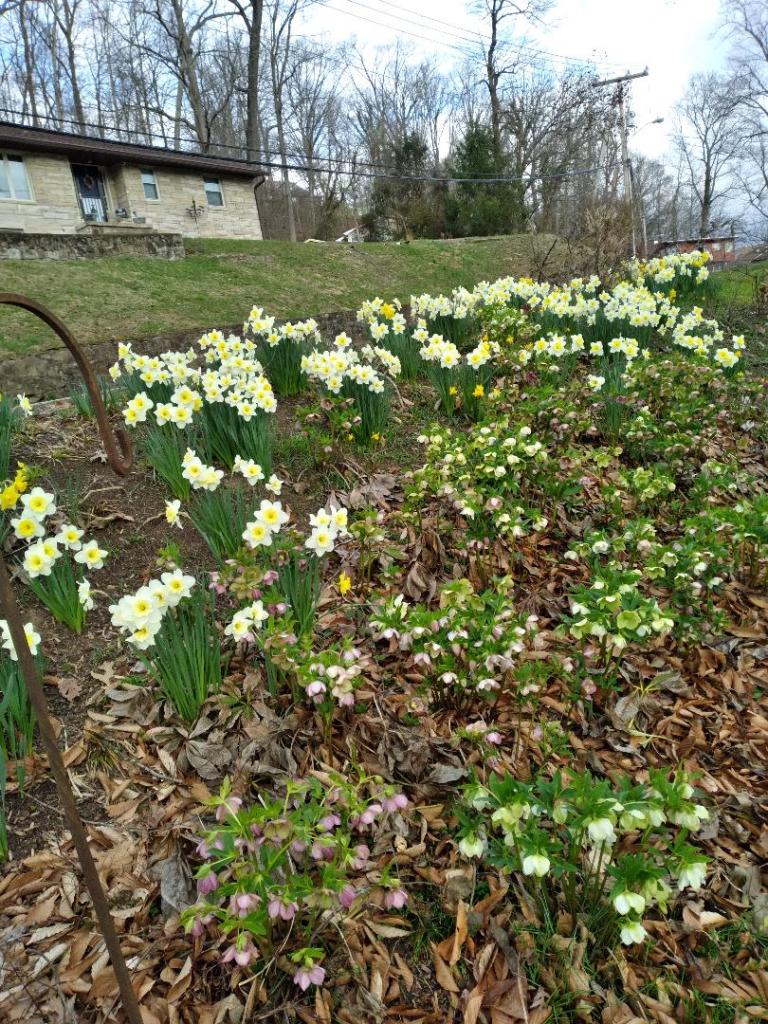
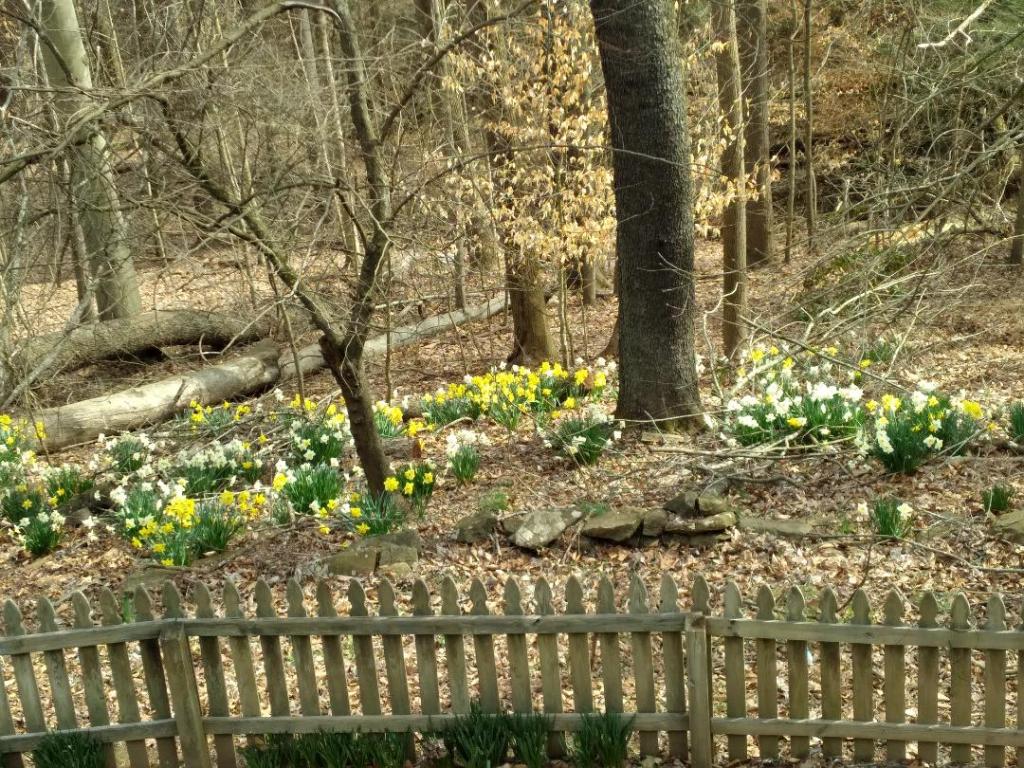
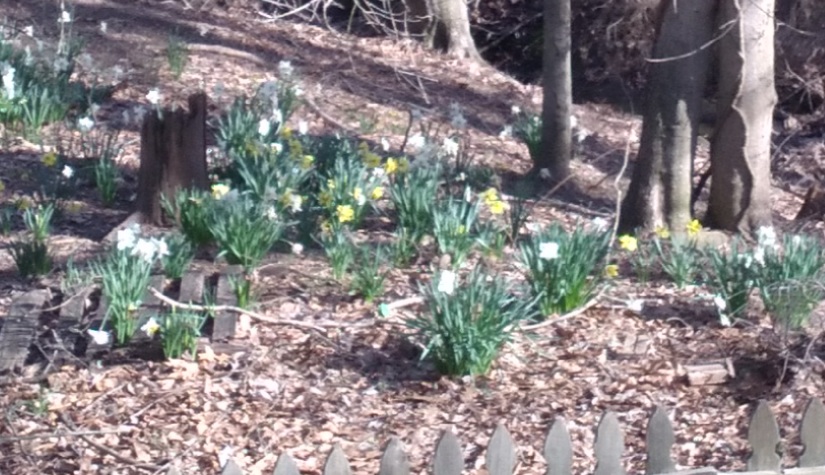
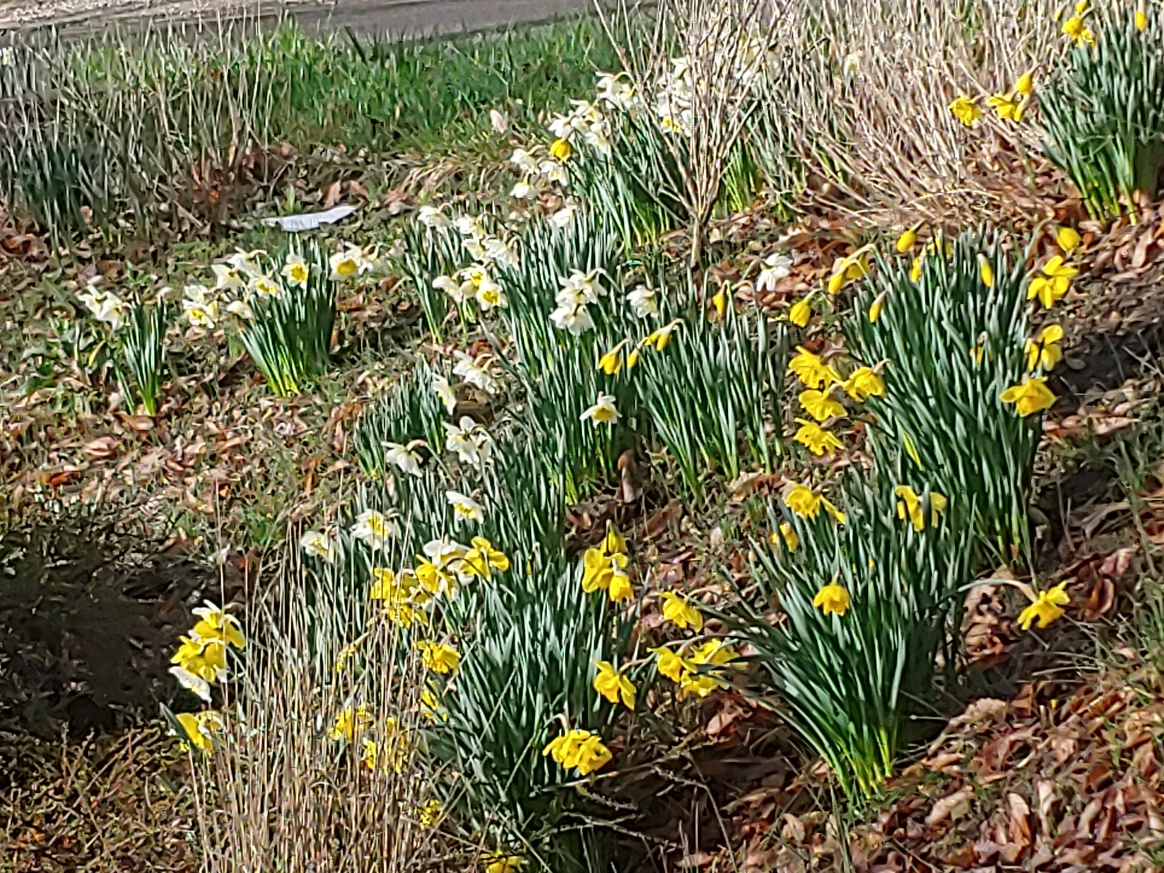
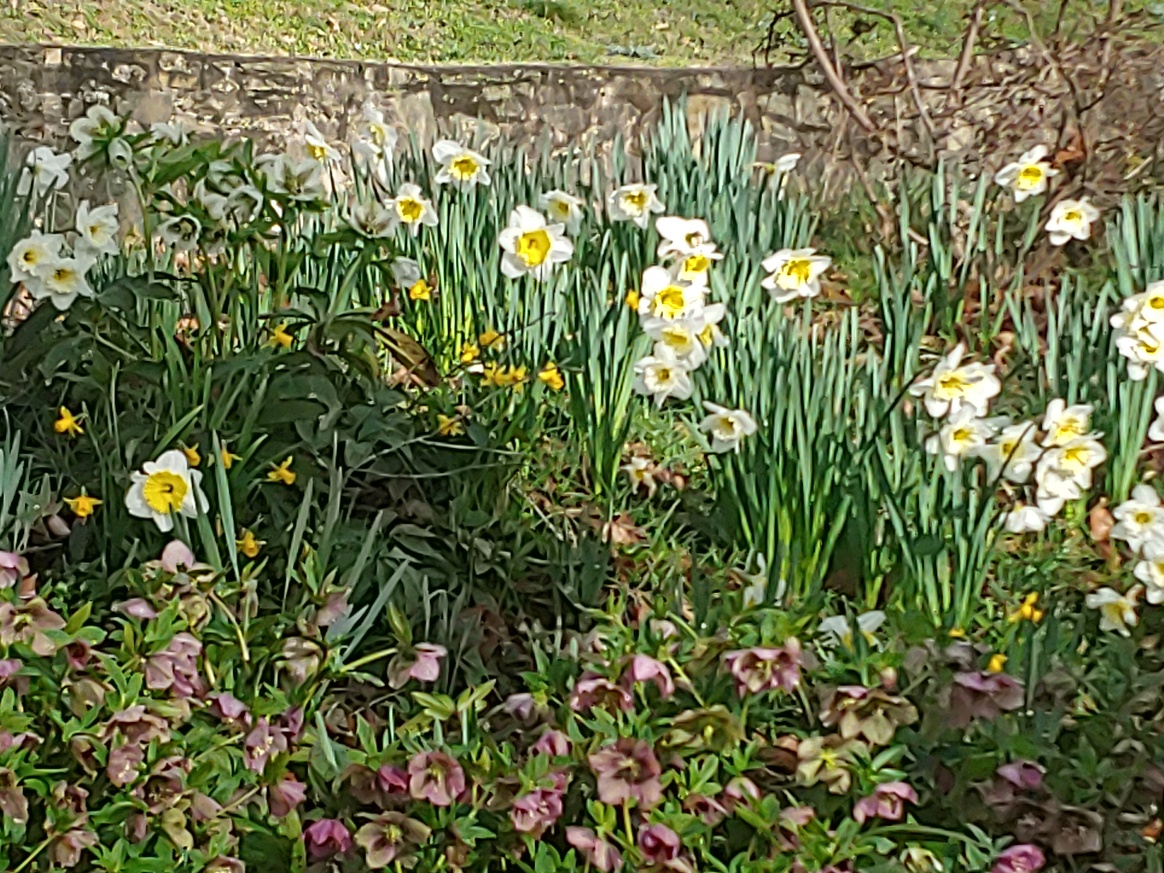
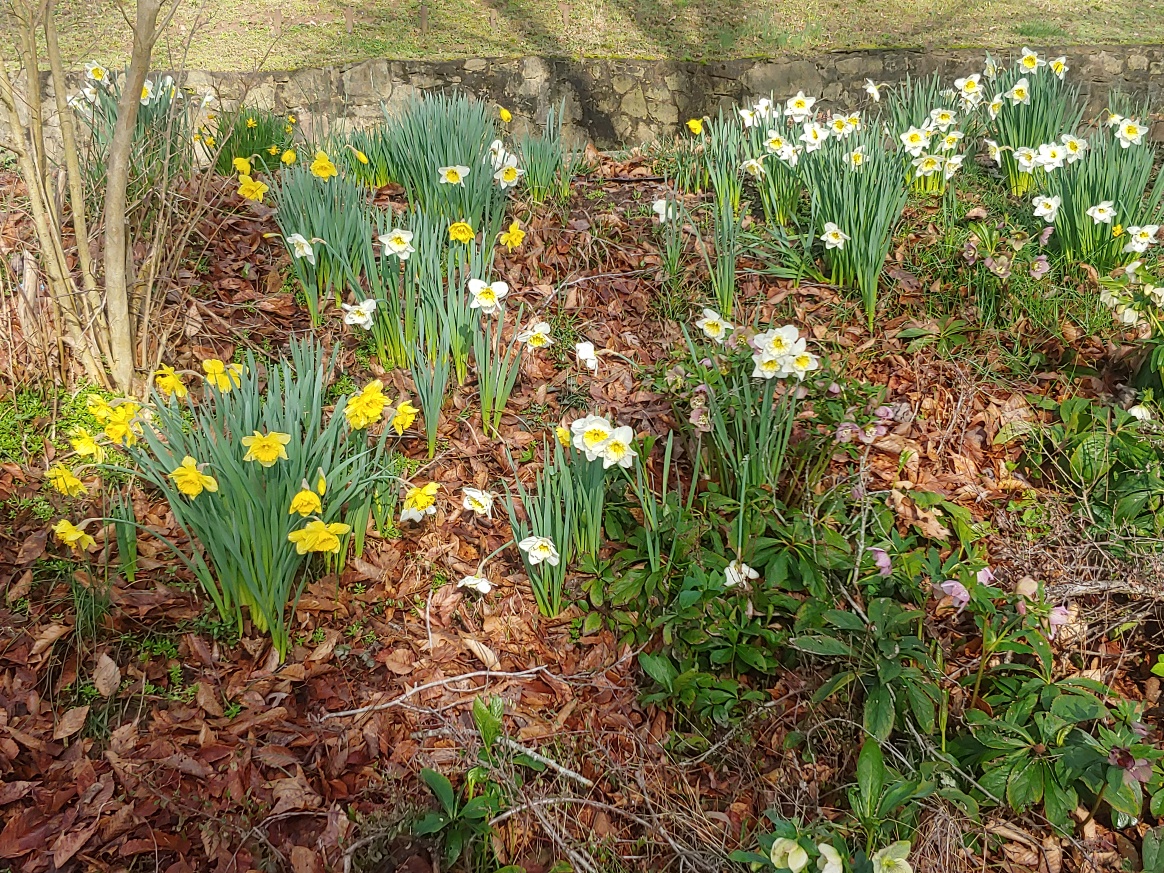
The daffodils began blooming on February 20. This was extremely early for Spring to appear in South Charleston, West Virginia. And it was not the little daffodils breaking forth first, but the hordes down the hillside where I have spread bulbs in the 30 years we’ve lived in this house. I am enclosing three pictures in this post, two showing the hillside in front, and one showing the blooming bulbs in back of the house. Not shown are the blooms around the gardens, the blooms in between our neighbor’s house and ours, or any of the blooms we have encouraged at the interface between mowed lawn and natural woodland on the side of our property. Indeed, at times like this when all of the bulbs burst forth simultaneously, you can see the thousands of blooms we have in our yard, and I have the pleasure of knowing I’ve placed a majority of these bulbs myself. I grin when I see the bees grabbing the pollen from these early flowers.

I have not purchased bulbs for years. The last virgin bulbs I planted were left over from Easter displays at our church, where the blooms we sponsored became available after everyone tired of the Easter joy. That’s where the small daffodils which normally pop out first showed up. Not this year. The only bulbs not showing up are the jonquils, which always come last, and have multiple flowers per stem, so they appear to keep the bloom parade on track. Instead of purchasing bulbs, I let the greenery die down naturally, and that leads to giving enough energy to allow the bulbs to bud with new bulbs. Since these new bulbs always are higher than the parent bulbs, eventually the bulbs crowd the surface, and show up when I am weeding the beds. That is my prompt to dig up the bulbs, and replace a few back into the original holes, where they begin to repeat the cycle. I’ve dug up hundreds of bulbs in some years, and distributed them to relatives across the country, and to many in this city. It is always good to hear others talk about the blooms they have each Spring due to our efforts.

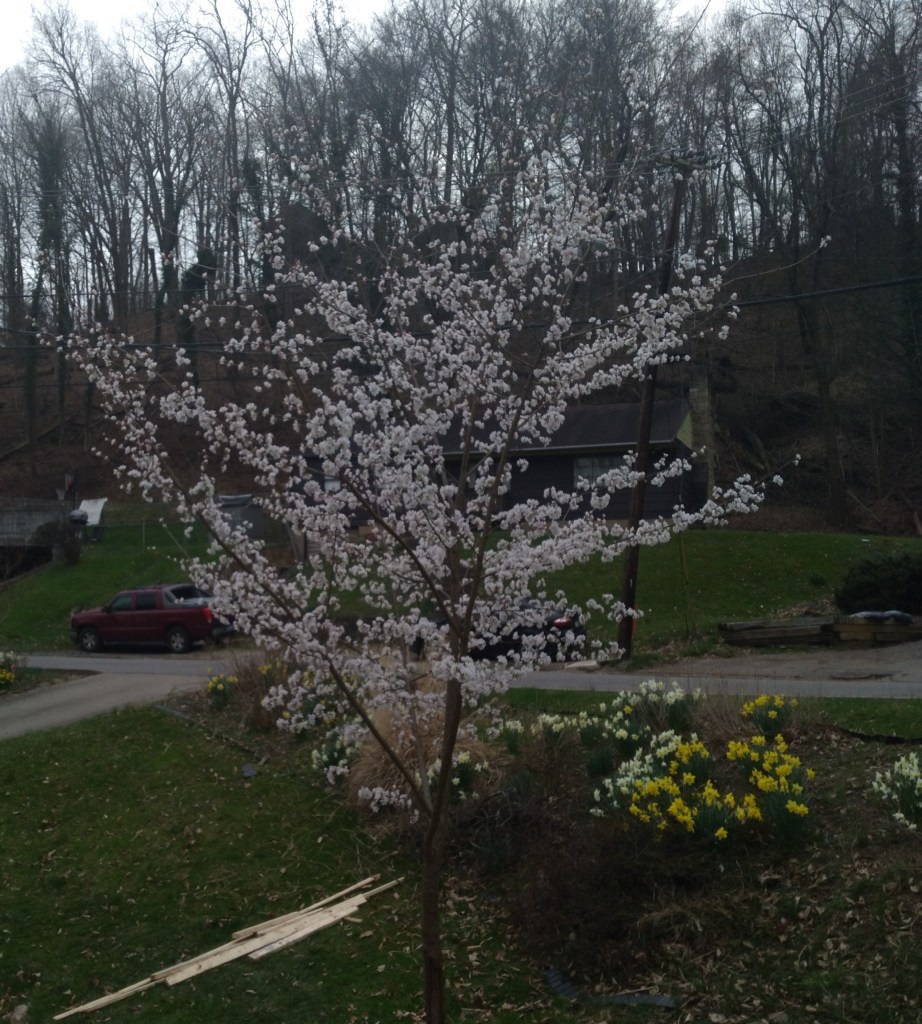
We subscribe to the New York Times. One of the commentators I enjoy is Margaret Renkl, who is based on Nashville and sometimes writes on the nature she sees outside of her window. On March 6 her column was titled ”The Beautiful and Terrifying Arrival of an Early Spring”. She commented on what she was seeing (blooming bulbs, flowering trees bursting out into full color, and birds confused on what signals to follow as part of their annual routine). She mentioned the risk these early spring adopters ran from late winter cold snaps. Well, we are now in the midst of several days with lows in the low 20’s Fahrenheit, and we are running the risk of ruining the early blooms. So far the daffodils seem impervious to the cold, but we will see what happens to the Lenten Roses and the flowering cherry tree now bursting forth to declare Spring officially here. We just had a story about the storm of the century, back in ’93. We were here for that blizzard, so we know winter still can throw a nasty trick at us. But somehow, I think the plants and animals in this area will adjust to the vagaries of the weather, and even if some of the blooms are withered by the late cold, we can look forward to the days ahead where the daylight savings time change enables later afternoon, and soon evening work hours in the warmer temperatures of Spring.

Choices People Make

This post is kind of hard to write. I am making the point that some things are inherently better than others. In doing this, I am claiming my membership in the “elite” class so many people wish to dismiss. Indeed, I am asking to be “owned” as a card-carrying lib.

First, let me address something that I hope is local to Appalachia, though I fear it has spread across much of the country. I think those who participate in, and attend “Toughman” competitions, represent a failed class of humanity. A bit of explanation, in case these events are not universal. These are competitions where untrained amateurs put on boxing gloves, and go and whale away on opponents who are likely as unskilled as they are. In between rounds, examples of Daisy Mae femininity parade around the ring, holding up the round numbers. In one fell swoop, this commercial enterprise manages to denigrate both the men and women of Appalachia, as only being capable of serving as cannon fodder or as sex symbols. Since these events have survived for decades in this market, I believe they serve to confirm the stereotypes hung on the residents of this region.

I believe classical music and jazz represents a higher capability when compared to rap, hip-hop, and country music. It is harder to make the notes on the scores come to life when you compare classical to these other forms, and as such, I believe it is better to have one’s music come from the classical repertoire. For jazz, the writing is minimal. You must internally improvise the chords and harmonies. Certainly you can write a memorable song only using 3 chords. But that does not mean you are a musician.

I believe most television is aimed at the lowest common denominator. Certainly the plethora of reality television shows represent some of the worst of humanity. Anything that allows mankind to exist vicariously and enable people to feel either envy at the lifestyles of celebrities, or wishing they had the physical abilities on certain reality shows, those shows further the misallocation of mental resources made possible by visual media. The popularity of TikTok videos, in five second increments, shows how the diminishing of the attention span is progressing quite well.

Even in our choice of weaponry, we seem to want to reduce our functioning capability while increasing our dependence on technology. Whereas shooting sports used to require skill, and superb hand-eye coordination, now we just get a semi-automatic weapon, point, and shoot aimlessly. Perhaps we are fortunate in that simply spraying bullets is normally less lethal than someone who is trained on their weapon. Let me just say that I do not measure my worth by the number of weapons I keep around the house. Those who seem to live in a permanent state of paranoia of the “government” coming to take their weapons are inferior to those who want to live in peace among their neighbors.

Let’s see, whose oxen can I gore now? We could talk about all of those who feel a perfect monoculture of grass is the highest form of landscaping possible. The ones who keep the landscape companies in business applying endless quantities of fertilizer, herbicide, and insecticide all aimed at turning suburbia into a boring sea of grass. They are the ones who on a small scale are responsible for the loss of pollinators and birds we see around us. They will never have the joy of watching naturalized crocus bloom in their lawn as a harbinger of spring every year.

To all who not only are incapable of understanding scientific principles, but actively work at diminishing them and proselytizing against them, you have my scorn. It is amazing in this day we are still seeing state legislatures devoting time and effort towards implementing intelligent design (ID), but that is the current condition in West Virginia, where the ID camel has stuck its nose in the legislative tent. Of course, research has found a higher death rate in the counties where science denialism is more widespread as compared to those counties repudiating those anti-intellectual beliefs. Only a few more generations and mankind may evolve towards a belief in science. Too bad we have to deal with the idiots in charge in the interim.

I believe the underlying cause for all of the issues I’ve identified is money. People go where the money is. And unfortunately, people are willing to spend money on those things which tend to feel good, but don’t last when looked at from afar. If people didn’t buy rap or hip-hop, we would not find it infesting our culture. If there wasn’t peer pressure to maintain a “perfect” lawn, lawn chemical companies would find more useful ways to serve society. If people stopped contributing money to those hypocritical politicians who give voice to populism, but really just want tax breaks for wealthy people, then we might get a political class that wants to solve real-world problems. I am not holding my breath waiting for sanity to sweep over this land.

Some of these distinctions are real, and cause much of the division between people we find in society today. Some seem like minor irritants (like reality TV – no one is making you watch that). But there is a deeper meaning to be found in people’s preferences. In most cases, people go for the easy solution. That is a primary reason why people find it difficult to postpone gratification and save for the future. If you are lucky, you will win the lottery and never have to worry about the future.

Hummer Court Is In Session

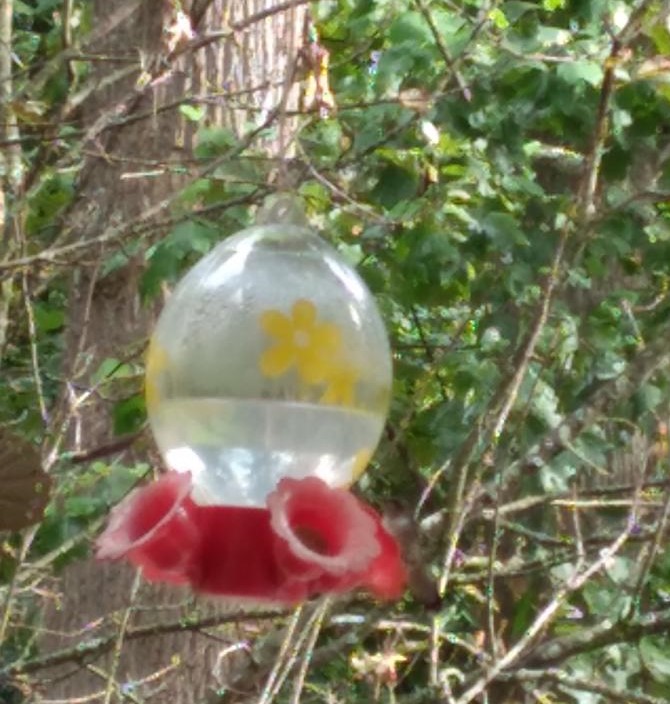
Hummer is at lower right

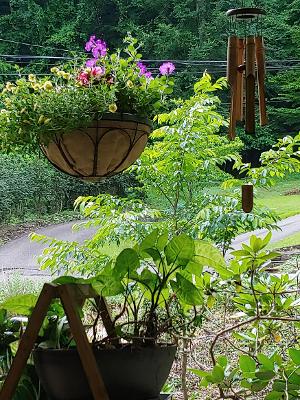
 Zip! Zip! Zoom! The hummers swerve around us in their aerial battles for supremacy. Their distinctive wing sounds, coming from flapping literally hundreds of times per second, coupled with their chirping sounds, alert us to their presence. We put up two feeders, both on our front porch. Early on in the summer, a single male takes charge, but there’s not a huge rush on the feeders. Somewhere in July, though, competition sets in. A second male hummer dares to drink from the feeders. Well, the alpha male hummer cannot stand for that to happen. We begin to have hummer wars on our front porch, with two and sometimes even three hummers chasing each other. The original alpha male drives off the interlopers, and he goes to perch on a bare branch of an apple tree, or on the wires leading to the house. It is amazing to see the degree of competition we have for our sugar water. Best way to use ½ cup of sugar ever! Cheap entertainment. I must say I would not want to have a hummingbird attorney to ever argue a case of property rights, though. They are quite capable of putting on an effective defense among their peers.

We once put a feeder out in the back off of our deck, figuring a single hummer couldn’t observe both sides of the house at once, and thus we could support more hummers. What we hadn’t figured out was that raccoons could reach the backyard feeders, and we awoke to empty hummingbird feeders after a single night. We knew no birds could do that, and we did make an inference on the raccoon, but the image of a raccoon on a sugar high, bouncing off of the trees below was too good to forget.

Our summer outdoor living room is shared by many other life forms. This year we’ve had a bumper crop of skinks scurrying across our space. Not just the ones with neon blue tails, but another type with brown coloration. And we have had flickers at the hummingbird feeders, who are free from hummer raids. They seem to know it would not work to challenge such a large animal. They wish only to intimidate their own kind.

We even had another reptile pay us a visit this summer, and it provided quite a counterpoint to the frantic aerial pursuits of the hummers. A box turtle showed up, and we always are glad to see the slowest of animals still managing to survive in our urban environment. I say urban, because we do live on a city street, with a few thousand cars passing by daily. But when I look at the deer population, it becomes clear we only are the temporary residents, and the wildlife is the true inhabitants of our space. We do our best to welcome as much as we can, offering a multi-cultural lawn for any herbivores, and keeping our crab apple tree available for the squirrels.

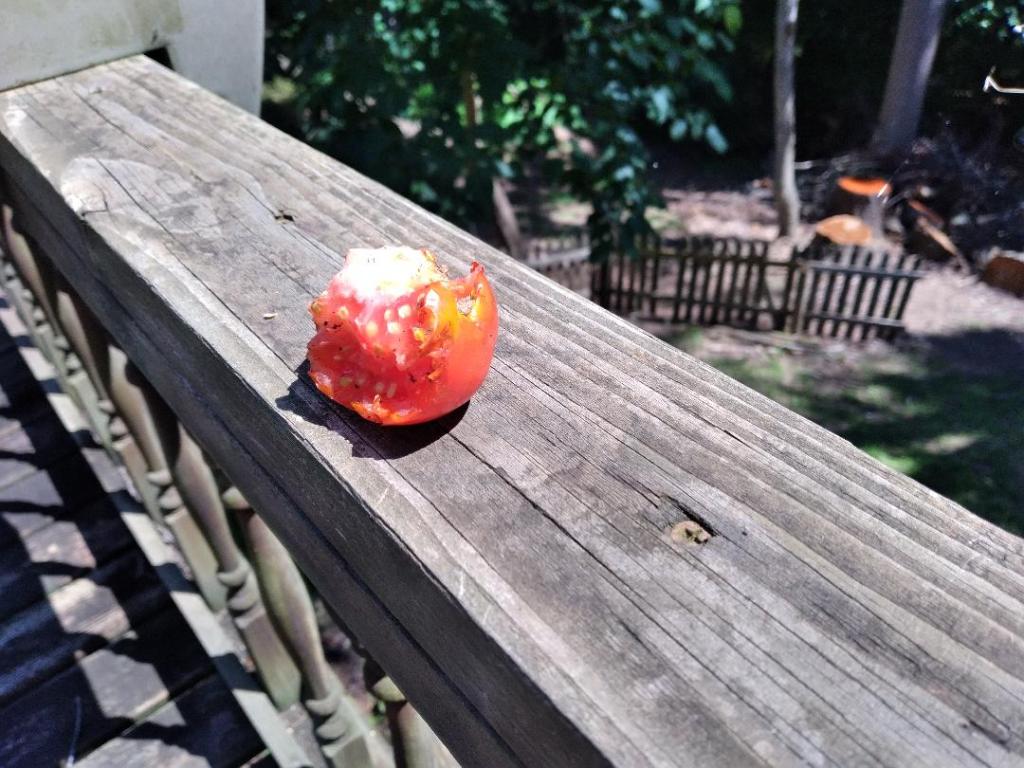
I may have an argument or two with the squirrels, though. I have seen half-eaten tomatoes littering the back deck. I’ll be willing to fight for the tomatoes. Unfortunately, they won’t touch the excess of jalapenos growing in the same space. But watching the acrobats of the mammalian world stretching out on flimsy branches to grab a crab apple, scurry to a more secure perch, and just sit there gnawing at the bitter fruit. To them it must be a welcome change to their diet of nuts.

Soon enough the bounty of summer will be replaced with the need to stock up for winter. The chill of the fall evenings will cut through even the fur coats of all of the animals, and we’ll see the suicide squirrels who don’t make it successfully across the street. One day, our hummingbird feeders will be silent, as only the wasps still seek concentrated sugar. And wasps don’t make much noise. When we move the plants indoors, seeking to avoid the killing frosts, we will bid adieu to our outdoor living room. Until that time, though, we sit and watch the natural world intersect with us.

A Delight of Daffodils

Front bank

Spring appeared spontaneously in March. We went from total winter inertness into a delight of daffodils almost instantly. Plus the bonus of flowering trees and Lenten Rose in full display. Even the brief interruption of 8” of snow a couple of weeks ago couldn’t stop the procession of the seasons.

Our daffodils represent 30 years of living in the same house. I’ve managed to spread the daffodils not only to all niches of our yard, but pass the bounty on to many others in the Charleston area, and establish outposts in Ohio, Richmond Virginia, and near Ft. Worth Texas. It is easy to be generous when you only have to dig up the bulbs that are crowding the surface and replace the lot with a few of those I’ve extracted. Now is the time – the 3 or 4 weeks in the spring – when all of the past work shines in its glory. Soon will come the jonquils as the last blooms of the spring, with multiple flower heads making up for the lower numbers of bulbs.

Daffodils below fence in back

Then all that will be left are the green leaves of the flowers. If you merely leave these in place, until June when they tend to blend with the dirt after they’ve fertilized the bulbs below, you will be guaranteed of flowers next spring. And for us, the added benefit is that the deer will not touch them. They dislike both the daffodils and the Lenten Rose, so we’ve cultivated both of these species to colonize our slopes and shaded flower beds.

Cherry tree in front yard

With my knee now functional, I should have much less of a problem in getting down on the ground to weed the flower beds, and dig up those bulbs whose heads poke up above the ground. I’m looking forward to that, since for the last few years it has been a struggle any time I sank down to the level of the flowers. If I could only find flowers that bloomed later in the year that deer wouldn’t treat as their buffet, I’d be happy. We try lantana every year, and sometimes it does not get munched, but it is not immune to the deer predation. Plus it gets expensive to buy lantana by the flat. So far we also have found lavender that deer don’t like, so we’re going to try some more of it. Plants like coneflower have not done well for us.

At least I am only worried about the marauding deer disrupting our flower beds. I am grateful that I don’t have to worry about tanks and armored personnel carriers and the boots of the enemy tromping around. I feel for the people of Ukraine, who will find this year’s spring to be a hollow reminder of what should be instead of what is.

Make West Virginia Great Again!

So this is what it’s like being dragged kicking and screaming into the 21st century. Here in West Virginia, we are being blackmailed into continuing the use of coal for electric power generation until the year 2040, regardless of the economics. And we are going to pay dearly for the privilege of using the dirtiest fossil fuel extracted from the earth in the most damaging way possible. How is this possible? Let us say when we selected a coal baron as Governor, we accepted his appointments to the Public Service Commission (PSC). And when a position came open in the 3-member commission, the Governor filled it with the recently-retired head of the WV Coal Association.

There are three large power plants run by Appalachian Power in the state of West Virginia. These plants sold power throughout West Virginia, and also to Kentucky and Virginia. All three plants face the need to upgrade their sludge handling facilities by 2028 in order to meet EPA regulations. The Kentucky and Virginia PSC’s refused to accept their portion of the costs for upgrading the water treatment facilities, so it fell to the WV PSC to make its decision. To no one’s surprise, they approved the half billion-dollar upgrade, along with the requisite costs for the utility to not only offset its investment cost, but enable Appalachian Power to earn a return on the incremental investment. The PSC stated their rationale for approval as: “Direct employment at the Plants, use of West Virginia coal, state, county and local taxes related to operating generation plants and related employment in businesses supporting the Plants and the coal industry cannot be discounted or overlooked.” I can’t wait for the first shipment of Wyoming coal to these plants, justified solely on cost. Lower cost will eventually out trump any other justification.

When I moved to West Virginia in the late 1980’s, a point of pride in the state was the low cost of electricity as it was totally dependent on coal generation. Since those days, a revolution in energy generation has occurred. Natural gas availability has increased exponentially, and the cost of renewable energy has plummeted. At the same time, the deep thick veins of coal have mostly played out in the state, and the coal industry has resorted to the extremely destructive and disruptive practice of blowing off the tops of mountains in order to expose the relatively thin veins of carbon remaining. So now we suffer from periodic explosions causing rock to rain down from on high throughout our coal fields, and then suffer from the exposure of virgin rock to the atmosphere where every metal present is leached out into our streams. All for the pleasure of allowing our neighboring cloud factories to vent their excess heat into the atmosphere.

Much has been written about how coal has held this state captive for over a century. Coal mines, and coke ovens, have plagued us ever since industry began to exploit this resource. Of course, you wouldn’t want it extracted in your back yard, since the act of extraction just may make your yard and house uninhabitable. But we are still held in thrall to the large utilities and their subservient governmental regulators, all under the massive oversight offered by our oversized Governor. It makes sense that the state suffering from rampant obesity should select an exemplar of this trait to be its leader.

So while the rest of the nation learns how to adapt periodic energy sources into a system which can handle volatile energy demands, this state will muddle along with the power system of the last century. Once more, West Virginia is insistent upon remaining a vassal state to the rest of this country, and ensuring our subordination for multiple decades to come. A state looking ahead would try to market the flattened mountains as opportunities for solar farms, since the soil won’t grow useful plants due to the dearth of organic top soil. No, instead we will continue to permit the desecration of our lands in order to fulfill our need to pay obeisance to the gods of coal.

Do we deserve to be last in almost every economic category within these states? It would seem so, since we appear destined to race backwards rather than face forward and try to improve. The state has changed from a progressive labor enclave, into yet another southern US state where the Republican party staged a takeover. Law after law is enacted aimed at hamstringing the labor movement, many straight from the American Legislative Exchange Council (ALEC) playbook. It makes you believe the legislators have no individual capacity for thought, they have to outsource it to ALEC. But those are the facts on the ground, and we have to deal with the unfortunate circumstances we find ourselves stuck in.

It may be that all politics are local. What is unfortunate is that the local variant of politics in this state consists of denigration of education, followed by an insistence on wishing for an economic rescue from the economic gods of the past, instead of realizing the facts on the ground have changed, and no longer will we thrive if we refuse to look beyond coal. There is a reason why the coal extracting regions are among the poorest in the world. Only when you think coal is the only resource you have to share, will you accept the degradation it brings. Here in West Virginia, we think we only have coal to offer to the rest of the world.

Late Summer Sights and Sounds

bird butt

Summer is winding down, but the battles of the animal kingdom on our front porch continue unabated. It was a long time ago now that we beheld the image of the two wrens feeding the baby cowbird that replaced their true children. The cowbird suddenly one day chose to climb up the flowers in the basket that held their nest, but still cried out for more food. Then it was seen for a few days in the rhododendron below the nest, not yet ready to fly away, but still begging for food. Then, all at once, it disappeared. The parents of the cowbird did show up one day for a look-see, but the battle where the original eggs were displaced by the female cowbird went unseen by me.

We put up a mealworm feeder next to the wren’s nest. First we put it up because we thought it would make the life of the wren parents easier, but it took the wrens a long while before they discovered its bounty. No, what came first were the mockingbirds and the tufted titmice. Soon they scolded us whenever the feeder ran dry. We’d replenish the store and were treated to seeing the mother mockingbird (assumption) having to provide to two fledglings who squawked noisily for their share. They were as big as their mother, but still were dependent upon her largesse. Soon, though, we’d notice the feeder was running empty much too fast. Then, one day when I was on the computer in the room adjacent to the porch, I heard a commotion out there.  I looked to see a squirrel hanging on to the swinging feeder for dear life, only to lose his grip and fall noisily to the plants below. We tried to coat the aluminum pillar with vegetable oil, and that worked for a while. The squirrel didn’t try the direct approach for a day or so, but would scale the brick wall and climb up onto the roof. There we were treated to seeing the head of the squirrel peer over the edge, first showing up on the yard lights, next trying one of the hooks for wind chimes, trying to figure out how in the world to reach the succulent treats found in the feeder. He ended up sliding off of the porch roof and landing directly on the walkway. Squirrels, though, are tough and resilient, and he just shook the fall off and scampered away. Now I am attuned to hearing the feeder being attacked, and go and open the door, which is normally enough to cause the critter to jump down onto the porch railing, staring at me for a while until I move in its direction. Then and only then will it jump down and go around the house.

mockingbird

I believe this is the same squirrel that found my hose from my propane tank to the grill to be so tempting. Normally the propane cylinder sits nestled inside of my grill and I’m able to close the door. This time, though, the cylinder would not allow the door to close, allowing the squirrel to find both the wonderful grease pool, and the reinforced nylon hose coming from the cylinder pressure regulator. I can’t imagine the squirrel’s surprise the first time he bit into the hose and it began hissing at him, but after a while the hissing stopped, and my guess is that somewhere up in a squirrel nest I would find the remains of my partially dismembered hose. I hope it keeps the squirrels warm in the upcoming winter.

Since it is nearly the end of the summer, the hummer wars have become even more intense. There are at least three birds engaged in aerial combat now, and the maneuvers go on through the yard and out across the street. It is amazing how you can see these tiny birds from so far away, but once you are used to looking for them, you can see them everywhere. I see them perching in trees even before they have approached the feeder. All because I know what I’m looking for. But someday soon, these birds will just disappear. Our local birds will begin their migration to more southern climes, and we will be left alone with just the flicker and the wasps gorging on the sugar water. We keep the feeders up for a while to tempt any migrants from up north, but we know the time for watching the hummer wars is short, so we enjoy them while we can.

flicker

There is a sound found only in late summer. It is the symphony of the insects as they buzz incessantly in search of a mate. Though we may have fewer insects now, you cannot tell it when you listen to the minimalist music of the crickets, katydids, and cicadas.

The season is inexorably changing. The streetlight now comes on at 8:00, while in the midst of June, it was nearly 9:00 before it turned on. Eventually we will be unable to sit out in the morning without long pants and sweatshirts on, as the temperatures begin their yearly plunge. We’ve taken part in outdoor dining during this time of the pandemic, but realize that we are on borrowed time for that as well. Just hope that the restaurants can survive this coming reduction in their business. While the virus keeps up its relentless pace, it reminds me of a wolf pack stalking humanity, seeking out the weaker and the elderly to attack and kill. Now, though, things become serious. This week we are seeing the first week of high school football being canceled in my county due to local virus conditions. You may infringe upon many things in this society, but if you cancel high school football, you are really in trouble. We will see what comes of this.

Summer Reveries

Summer flowers

It is good to know in the midst of all of the concurrent crises we face, that nature  proceeds at its own pace unconcerned with all of the worries humanity has. Thus we return to summer in West Virginia, where the biggest issue is whether the cowbird will be successful in laying an egg in the wren’s nest up in one of our flower baskets.

We are loving it out in our outdoor living room, where we enjoy our coffee and newspaper in the mornings, and use its space for our afternoon cocktail. In between we can read or just watch  nature as it visits our porch. The finch feeder is in use most of the daylight hours, with the purple finches unafraid to visit while we sit there, though the gold finches are shy and only visit when we are not present. We were treated to seeing a hummingbird chase a finch away one day, though what the finch did to draw this attention is unknown. This year we are not seeing any non-conforming finches, where a brood is raised that includes a foreign egg from a cowbird. Last year we saw a young bird that was unable to use the finch feeder, though it tried valiantly. Instead, it chirped and waited for its father to deliver a seed directly to it, since it could not reach into the feeder with its own beak.

A wren built a nest in one of our hanging flower baskets. You can see it dart in and out, and it often scolds us, especially when we are at the table with our coffee. That puts us directly next to the nest, and that is obviously too close for the bird’s comfort. But it is the cowbird couple that is the most interesting. Last week I saw the couple, with the male perched a few feet away while the female scoped out the nest. At that time there were obviously no eggs there, and they flew away. But just yesterday I saw the female eyeing the nest again, and this time the wren flew directly at the cowbird, chasing it away. It remains to be seen if the battle will have future acts.

The fallout from the finch feeder keeps other birds busy who do not have the physique to feed directly from the feeder. Often we can hear the whooshing of the morning dove wings as they fly away after having poked through the rubble looking for intact seeds. And chipmunks cross our porch regularly, stopping sometime to search for seeds, while other times stopping under the hummingbird feeder and lapping up the spilled sugar water. Then they hustle off to whatever their business is.

This year I’ve seen not only the neon blue skinks skitter across the porch, but another color of skink. They are fast and you have to really be watchful in order to see them. So far they are the only reptiles we’ve shared our space with.

The flicker loves the hummingbird feeder. It will hang off of the feeder, and you can see it drinking as it brings the liquid into its beak and works it down its throat. The hummingbirds know that they cannot force the flicker away (too big), so an uneasy detente exists where the hummer will visit the side of the feeder opposite the flicker. It is amazing how much entertainment you can get out of a half-cup of sugar dissolved in water. We have seen at least one hummer battle, but know that more are to come as the alpha male perches on the wires leading to the house, keeping watch and driving away any other hummers who dare to intrude on its designated home turf.

2018 flicker

Several years ago we had to take down the hemlock tree that graced our front lawn due to storm damage. We replaced it with ornamental trees that won’t grow as tall so as to threaten the wires. The ornamental cherry directly in front of our porch is growing daily, as you can see the new leaves stretching higher each time you look at it. It may never give us shade, but that doesn’t matter to the birds who use any location as a handy perch.

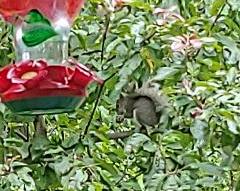
We have apple trees which have very seldom given us apples. Not because the apples weren’t produced, but because the squirrels get to them first. But until this year, they’ve always left the crab apples alone. The tartness of them must be a turn off even to voracious squirrels. This year, though, the squirrels are taking the crab apples right off of the trees and eating them.

Squirrel

It is good to take the time to really see the world around us. If nothing else, this time of physical isolation and separation from the rest of humanity, has intensified the desire for watching the world of nature. It is good to realize that the life outside does not care about human pandemics, or divisive politics, or any of the other matters that occupy the airwaves. Just hearing the sounds of birds, and the chirring of the crickets helps to put things into perspective.

Only a Cold

2020 daffodils 1

I caught a cold last week. It showed its ugly presence on Saturday, with spasms of sneezing, a sore throat, and a developing cough. In the four days since that time, I’ve persuaded myself that it is not the dreaded new disease (no fever or chills), and that the disease is receding as I would expect it to. But its appearance even in the time of increased precautions against viral invaders shows that the new virus can be just as sneaky and opportunistic.

It is amazing how quickly the world has changed. Last week at this time, we were still looking forward to taking a trip to Key West for some hedonism. That was before I saw a cumulative display of disease cases day by day since January. When you see for yourself that the rate of reported cases was increasing by 12% per day, the numbers came alive for me and told me that if we ran the risk of taking a trip, we were not going to have a good time. Even if we safely ran the gauntlet and did not catch the disease, our time of relaxation would be ruined by worrying about making it back in one piece.

Having a background in math and statistics made it clear to me that we are in a global exercise we’ve not gone through since 1919. When a new virus emerges and passes into the human population, one that no one has immunity to, and one that appears to have a significant mortality factor, you have to watch it closely in order to gauge its infectivity and its effects. What is ironic is that China and the US shared an initial response to belittle the potential harm that this virus posed. In China, this resulted in the doctor who raised the initial alarm being censured by the Chinese state, prior to the time that the doctor succumbed to the disease. In the US, the potential for an epidemic was ridiculed by the President and his favorite press sources. We heard about the Democratic hoax that was aimed at bringing down the President. Even today, as of March 17, you can see a post by Dr. Ron Paul decrying the response to this epidemic as being overblown. In both cases, China and the US, precious time was lost in responding to the emergence of this disease. They will only take this disease seriously when family members are stricken by the pneumonia this disease can cause, and those family members are turned away from all hospitals because they’ve had to ration respirators and only those under age 80 will be treated. That’s the decision they are making in Italy, having to ration their available slots to the younger population.

It is a bit jarring to hear myself described as elderly, but since I’ve now crossed the age 65 divide, I now fall into the target demographic for this virus. So far the effect for us has been canceled concerts and canceled trips, and a lack of church services. The chorus we’ve been working on for months, a performance of Carmina Burana scheduled for April, has not been canceled formally but since no one can rehearse for it, it is on borrowed time. Our children are out of the house, and though one son is working in retail and will likely take a hit, we are able to help him out if needed. If we are not hit ourselves by the virus, we will weather the storm relatively easily.

2020 daffodils2

But for the economy of the world, we are now seeing the issues caused by the streamlining of supply chains by linking to non-domestic sourcing of parts. For decades now, the maxim of running public corporations solely for the maximizing of return to the shareholders has caused businesses to rely fully on foreign partners, either for finished goods, or for creating semi-finished goods that get completed elsewhere in the world. Quality improvement processes preached the benefits of lean assembly lines, since excess inventory hid systemic inefficiencies. So more and more businesses performed global integration of their supply chains. That process worked well until there was a supply disruption at the original point of manufacture. If the ultimate goal is to have product available to sell, then some inefficiency may be needed to allow for supply chain interruptions.

The disruptions in supply chains will continue to ripple through the world’s economy for months to come. Add to that the immediate disruption in the lives of service providers who will be laid off from their retail and food service jobs in the coming weeks, and we have the potential for a huge decrease in economic activity during the year. Already the governments of the world are generating proposals for helicopter money to be shoveled out and spread across the land. All of it with money borrowed from our distant descendents. This crisis has the potential to turn into a debt implosion, with the destruction of much of the seemingly secure capital in the world through waves of bankruptcy and discharge of debt. Will this black swan event be the one that causes the world to fundamentally reset its economic system? Growing economic inequality and growing dependence upon government debt to sustain the illusion of economic growth are at the point of totally collapsing. When no one can keep the appearances up, what happens to the world?

The barren shelves in the stores and the anecdotes about pitched battles for the last shreds of toilet paper have shown us how close we are to unraveling as a civilization. As long as we had sports, and access to material goods when desired, and good restaurants to pig out at, then we were happy. But let us have one week where demand outstripped supply, and we see how thin the veneer of civilization is.

I figured that the tone of this post is so much bleaker than most of my posts, that I needed to leaven it with a reminder that there is still beauty in the world. The pictures are of my daffodils that have burst into glorious flower within this past week. Every year I have a couple of weeks of peak daffodils. This is their time, and a reminder that spring is coming, and better times are ahead. I leave you with a delight of daffodils. Stay well in the days ahead.

2020 daffodils3