
Pay Me Now, or Pay Me Later! Guess What? It’s Now Later!

Computer desk IBM 360 Desk Console

Want to cut down on the size and ineffectiveness of the Federal government? If so, then you will need to shell out significant dollars to replace the decades-old IT systems that the government uses for many of its programs. And you will need to rework many of the procurement practices and political machinations that have hamstrung efforts to update IT systems in the past.

It is not a secret that the IRS is at the rear of the organizations that are updating their IT systems. Two of the main systems for the IRS are IT antiques dating back over 50 years ago, running on IBM mainframes, with programming that is written in assembly language code. There have been requests to modernize the systems involved, but since the IRS is viewed as anathema to the Republicans dominating Congress, the trend over the past decade has been to cut IRS spending, not upgrade the systems. I actually remember IBM mainframes – the IBM 360 was the workhorse of the university computing systems at our school. The fact that essential government functions still run on a similar system now should bring shame to any who care about efficient government services. Indeed, it appears that up to $60 billion per year across the Federal government is being spent trying to nursemaid these antiquated systems through yet another day.

Not only does the government incur substantial costs for keeping these antiques running, it cannot achieve the efficiencies in service delivery that are possible if we use modern computer systems. I worked for over 20 years for my company installing and upgrading our business enterprise software. Our system was SAP, and in the early 1990’s I began work at a chemical plant implementing the mainframe version of this system. Beginning in 1999, I worked full time on SAP implementation for our department, and I understand the complexity involved in uprooting existing systems and implementing brand new business processes. The period immediately before and after go-live was always traumatic and stressful. But it is only after going through these efforts that it is possible to reap the benefits of improved IT. The increase in direct IT support costs is greatly outweighed by the reductions in support staff at the plants and in central offices. Not only are overall costs lowered, but the information that comes from such a system is up to date and accurate. When I began working at a plant, it took a clerk in each process in a plant multiple days to assemble the information needed for monthly cost reporting. These reports were circulated in a preliminary form among the management of the process, and eventually they were issued. Then the plant accountant would assemble all of the overhead cost sheets, and the allocated costs would be figured. All of this meant that cost information was never current, always subject to significant revisions, and provided only a snapshot once a month.

By the time I retired in 2015, cost data was available instantaneously for all products, including labor costing and allocated overheads. The manpower was greatly reduced at a site, the information was better, and managers could focus on factors within their control instead of trying to manipulate the reports to put their operations in a better light.

The Federal government cannot achieve the efficiencies that private industry has achieved, because the impetus to upgrade IT systems has not been sufficient to enable the departments to get the funds to implement the upgrades. In fact, lately this effort has gone in the opposite direction. According to the Government Accounting Office (GAO), Operations & Maintenance spending on IT systems has been rising year by year since 2012, while spending for modernization and development has declined. From fiscal years 2010 to 2017, such spending has decreased by $7.3 billion.

Even when funds are appropriated for upgrades, current procurement practices preclude efficient implementation. I am aware of an effort to implement a portion of business enterprise software for the army. Supposedly the contract for this project was approved in late 2016. However, due to the nature of government procurement, a competitor who was unsuccessful in the bidding process appealed the awarding of the contract. It has been six months, and there has not been any update on the resolution of the situation. Meanwhile, those employees who would have been assigned to the project are awaiting actual productive work at the government contractor. Such delays lead to projects running behind schedule and much above budget.

One reason why the funding has decreased for modernizing IT systems has been the sequester process for budgeting. With funding for discretionary spending flattened by decree, it has been increasingly difficult to gain support for funding for IT improvements. But for fiscal conservatives, it should be a primary goal to ensure that if the government must spend tax dollars, they should do it in a cost-effective manner, and in such a way that overall government employees could be reduced. Unfortunately, this approach has not reached the top 10 list of the Grover Norquist acolytes who view any increase in expenditure from a government agency as sacrilege.

Since the current administration is full of folks with business experience, maybe these types of modernization efforts may finally gain traction. This is one area where I do find agreement with the priorities of the Trump administration. This past week’s gathering of tech business executives with the administration did discuss IT modernization. My fear is that in this administration’s pogrom against discretionary spending, once more we will fall further behind the IT curve. Future archeologists will excavate data centers complete with mainframes and tape drives intact, and will marvel that these relics maintained their usefulness long after they had been abandoned by the world of business.



Make! America! Great! Again!

Trump's world


Let’s make America Great! How do we do that? First, let’s piss off every ally we’ve had for the past 75 years by insisting they all are out to rob us blind, and they don’t have the guts to fight terrorism the way we do. Next, let’s make it way harder for others to come to the US by implementing half-baked bans against certain religions to enter this country (we have to be oh so careful to be politically correct and not call them bans or the namby-pamby courts will rule against us, as if they actually are a co-equal branch of government).

We can make America great by creating our own sense of reality, where only what we say is the truth. And we can convey that sense of reality directly to the American People (We do love the people. They voted for us hugely.) in our tweets. Someday the tweets we make will be the basis for a little red book like that Chinese guy used to have. Everyone will wave a copy around to show how much they adore us.

We can make America great by leaving a lot of these government positions empty. Who needs all of these folks anyway. I can fire all of the US attorneys and not nominate anyone to fill the slots, and no one will notice. And diplomats? Do we really need diplomats, except for our favorite countries?

We can make America great by showing America how great leaders work. Like this guy Duterte in the Philippines. Wonderful how he’s leading by enabling those mobs to kill all of the druggies. Wish we could do something like that here.

We can make America great by cutting back on a bunch of silly spending. Why in the world do we need to invest in scientific research? What has science ever done for us? It’s not like our lives are longer than they used to be because of medical research. Or how is it that we gained anything from research into solid state physics. What a waste of time and money! Losers, all of them. Can’t wait to use my cell phone to post a tweet about not wasting money on basic research.

We can make America great by showing America how fake the media is. They won’t acknowledge our greatness all the time, so they are fake. Fake, fake, fake. We’d be better off if everyone just used my twitter feed to learn all they need to know about the world. Boy, I wish they wouldn’t keep asking those damn questions. Why do they keep harping on all of these things we did with our friends the Russians? You’d think they thought someone out there in the mid-west actually cared about selling out to the Russians. Love the mid-west. They voted for me when no one ever thought they would. Led to my huge electoral college victory. Biggest one ever for a Republican. Did you know I’m a Republican? I used to donate money to Democrats.

We can make America great by passing the biggest tax cut in history. I can get the Congress to do just what I want. Just give them the talking points and they take it from there. That’s Leadership! We haven’t had leadership in this country since Andrew Jackson. Tax cuts. Get rid of that stupid death tax. Do you know how much that would cost my children if we don’t get rid of that? Of course, I plan on living a long time. Did you see how my doctor said that I had the best health of any President EVER! No, we can just keep cutting the taxes and watch the money pour in. I can see 5%, 6% growth coming just because of these tax cuts. Just watch and see.

We can make America great by getting rid of that terrible thing Obamacare. Just get rid of it and we’ll have the greatest health care ever. Costs will go straight down. People won’t have to spend money on insurance since we will get rid of the requirement to have it. Shoot, I’ll just tell the IRS not to enforce the requirement. I can do that you know. I love to sign executive orders. I can get a huge crowd in the office just to hold one of these signing ceremonies. I love ceremonies. It’s like a parade, only just in one room. Did you see the parade for my inauguration? Biggest Parade and the Biggest Crowd ever! And those executive orders. Sometimes I read them before I sign them. Sometimes not. But we’re not going to cut Medicare or Social Security. That’s my pledge to the American people.

We can make America great by getting us out of all of these agreements and treaties with other countries. We never do well in these things. Get taken advantage of bigley. Like that NAFTA thing. Or was that the NATO thing? Both of them – worst treaties ever. Tear them up, start over, we’ll show them that you can’t take advantage of the United States! Did you see about those children over in Syria? I showed them who’s boss. Gave them a dose of Tomahawks! Just wait till that fat little punk in North Korea tries something. I’ll show him. Of course, it’s hard for a young kid to be running a country. I can understand why he’s had to be tough with folks, shooting them with anti-aircraft rounds. I know I could stand on Fifth Avenue and shoot someone, and my supporters would cheer.


Whew! I’m sure glad that Donald Trump didn’t get elected as President. What a horrible dream! Can you imagine someone thinking and acting like that? Wait. What’s that you’re saying? All of the things in my dream – they’re real? And all have taken place in less than 5 months? And we have 3 years and 7 more months to go? Where is that alternate reality we were talking about? I think I’m gonna need to live there in order to stay sane.


Not All Archeological Digs Are Below Ground

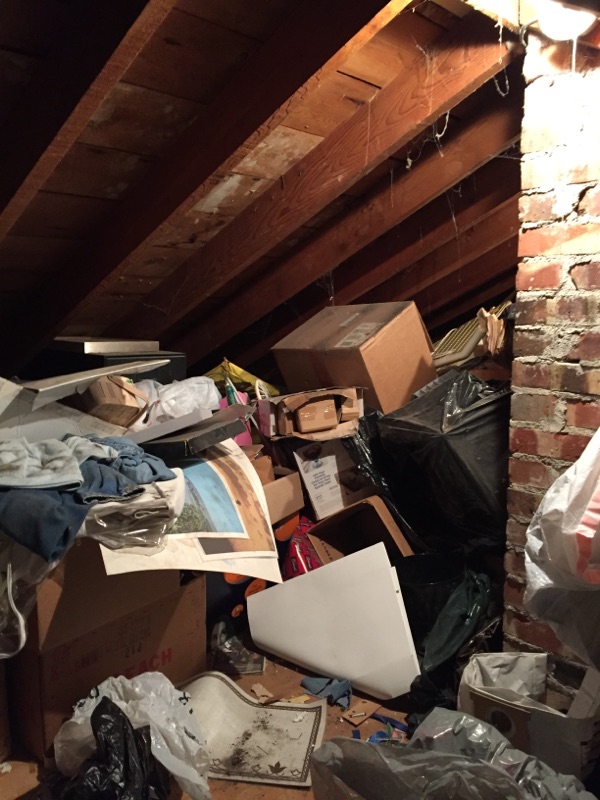
Attic before

We set up the plastic dust barriers from the attic, down the hallway and stairway, and out to the front door. Plastic sheeting covering handrails, much of the carpet on the steps, and all to prevent the potentially asbestos contaminated dust from escaping into the house. My brother and brother-in-law took the hard tasks of cleaning the initial dust off of the innumerable boxes stored in the attic, then hauling the boxes and bags down the stairs and out to the front yard, where we awaited with dust masks as I would blow the remaining dust off of the detritus from the attic.

My parents moved into the house in 1957. I did not realize it all through my childhood, but the attic was not just the place where Christmas decorations resided in sturdy apple boxes. No, the attic became a black hole that sucked all of the possessions and ephemera of a lifetime into its gaping maw. It was harder for it to serve this purpose for the first 20 years of their residency, since hoisting items to the attic required hauling the stepladder from the garage to the second floor, then up the steps into the attic, and finally finding a place for the new attic inhabitants. But in the late 1970’s, as part of home improvements, a collapsible ladder was installed leading to the attic. After that time, it became much easier to feed the inexhaustible appetite of the attic.

The removal of the attic contents became an archeological dig. As the available space for storage decreased, the recent articles tended to be near the opening to the attic. Thus it was items from the last decade that emerged first. As the excavation proceeded, it was fun to determine which decade we were into. The 1990’s emerged, then the 1980’s, and on back all the way to the early 1960’s and late 1950’s. What emerged? There was luggage. Every piece of luggage that they ever owned was still in the attic. From the metal suitcase that my father used to take his meager possessions to Purdue, to the latest Oleg Cassini suitcase that I claimed for my son’s use in the future. There were the two brown leather sided suitcases I remembered from my youth, along with the blue suitcases trimmed with white that were my mothers. There had to be at least 20 pieces of luggage that emerged.

Did you say clothes? Well, there were huge bags of blue jeans. My mother lived in blue jeans for much of her life, and when they wore out, they would find their way into a plastic bag and take the migratory route up to the attic. Did you need some ties? My father wore ties every day when he worked at the Nebraska Department of Roads, and even though we had already given countless ties away after his death, more bags full of ties came out into the sunlight once more. Mugs? Multiple boxes of mugs came down, along with pottery and figurines and glasses and plates.

Yes, there were the treasures we expected to find as well. The Tonka and Ny-Lint trucks we had used in our sandbox to dig and delve came out, though their bodies bore the dents we had imposed and the rust of ages. We’ll have to see if they are desired by collectors. The multiple boxes belonging to each of us siblings, holding our school memories. I could see my report cards all the way from kindergarten. The pictures of me in the plays in high school where I began my love of the theatre. All of the scholastic honors I got from high school and into college, with my notification of my Regents scholarship that paid all tuition for 16 hours per semester. In the 1972-1976 era, that was worth about $500 per year. Quite a change to now, with tuition continuing to skyrocket.

Other memories surfaced as the dig continued. Old pictures that had been replaced decades ago brought smiles. Chairs that had been superseded by newer seating made their way down the attic stair and out into the light again. The old pressure cooker once used for certain foods was intact, and the boxes of my uncle Bill’s remaining possessions surfaced. There were treats like the letter from Bill to his mother that had to be written so as to pass censor’s requirements.

But interspersed with all of the good stuff, was the chaff. So many bottles set aside as they were “collectors editions” of syrup. Ancient Windsong perfume dispensers. Old Spice bottles. If the bottles were clean, they were tossed into the recycling bin. Then, there were the magazines. Let’s start with the Reader’s Digests and the National Geographic’s. Decades worth of these magazines filled countless boxes. There were Popular Science magazines, and Boy’s Life from the early 1970’s. Even the most ephemeral of magazines, the ubiquitous TV Guide. I have no idea why these magazines were singled out for retention. At least they didn’t keep the weekly Engineering News Records that were delivered faithfully for years upon years, nor did they box up Newsweek or Smithsonian’s or any of the other historical magazines they loved in their later years. We would do a cursory search through the boxes of these magazines, to ensure that no other worthwhile item had been included in a box, but literally tons of these were either put out for recycling, or delivered directly to the dump in my brother-in-law’s pickup.

Not all of the paper was totally worthless though. My parents must have kept every card, Christmas, birthday, Easter, whatever type of card they received, they kept. Bags and boxes of these held notes and sometimes photos, and seeing the sentiments from many years ago brought back to light was fun. Unfortunately, those were outweighed by the years and years of bank records and tax returns that had to be sifted through to ensure that there was no information that would identify us as the remaining generation. I had forgotten that it was a relatively late development to add the social security numbers for dependents, so even tax returns held no new identity threat to us.

Then there were the work files from my father’s years at the highway department. Why he took so many boxes of records with him when he retired I’ll never know, but if you want the listing of the challenges facing the Nebraska Department of Roads in the 1980’s, we can point you to a section of the dump where it may be found.

The lesson I took away from this 4 day dig was this: If you love your heirs, clean up your stuff now so they don’t have to separate the wheat from the chaff. Leave only wheat that they will enjoy as they review your life well spent.

Media? We Don’t Need No Lying Media! (Or Do We?)

hoax-2097361__340


And now the coarsening of the political discourse continues. To think that a candidate for Congress, on the eve of his election, would be so easily provoked by a reporter’s request for a response about the CBO scoring of the AHCA that he would physically assault and tackle that reporter. That is amazing, but unfortunately it is part of a long chain of events that show a significant decline in the civility towards political discourse.

This coarsening is non-partisan in nature. Both the right (especially the alt-right) and the left are guilty of these incidents. The series of incidents with provocative right-wing speakers on college campuses where the speakers are prevented from speaking due to organized left-wing opposition, combined with anarchist activists who foment violence, has turned college campuses into no discourse zones. As for the right, we have only to review the footage of Donald Trump’s rallies where he excoriated the press, leading to situations where angry crowds surrounded press representatives, causing them to worry that physical violence would follow. And the reaction of Donald Trump to any protestor at his rallies did lead to protestors being assaulted by “right-minded patriots” as the protestors were being led out of rallies.

So the next phase of this war against free speech and the press has begun to play out across our land. In my State Capital building in West Virginia, a credentialed reporter trying to get a response from HHS secretary Tom Price was arrested and charged with “willful disruption of governmental processes”. As of this date, two weeks later, reporter Dan Heyman is still facing these charges.

In a little-reported incident in April, a cameraman for a Las Vegas television station was arrested for filming a tax-day protest on the Las Vegas strip. His crime? Not knowing that the sidewalk in front of an establishment was private property and thus subject to trespass limitations.

Now, with the overt hostility of the Montana candidate towards the press being expressed in a physical takedown of a reporter, the war against the press has taken a sinister turn to violence. It is only a matter of time until someone who feels empowered by the new attitude towards the press takes matters into their own hands and kills a reporter.

Both the right and the left need to step back and cool down. The lack of tolerance shown by the left against conservative speakers needs to dissipate. There are plenty of acceptable ways to demonstrate disapproval against a speaker instead of violently keeping that speaker from talking. And the phenomena of shouting down Republican representatives at town halls does not improve the political climate, as the attitude from the Republicans seems to be that those who protest, must be professional outside agitators paid by George Soros.

I am more concerned though, about the hatred shown by Republicans towards the press. There is a long-standing antipathy towards the press from many Republicans. They view the press as biased towards liberals and Democrats, and thus feel antagonism towards reporters. Then, with the ubiquitous use of cell phones for documentation, there is a paparazzi-like sense that politicians are legitimate targets for harassment from the press. But it is the characterization of mainstream media as “fake news” that is most disturbing. President Trump overtly declaring the media as “The Enemy Of The People!” Trying to delegitimize media as propagating only fake news and being the enemy is very dangerous, since many people no longer have a cultural reference point to distinguish between reality and illusion. The rise in social media as a primary news source for many people is a significant reason for this newfound lack of a cultural reference point. Ongoing balkanization of media sources leads to a lack of knowledge of real facts.

What can be done to reverse this trend towards abandonment of first amendment principles? All of us, regardless of political leanings, need to speak up in public against the war being waged on free speech and the media. This blog post is my own attempt to add my thoughts to the public discourse. I encourage anyone else who believes that we are heading down a dangerous path to also speak out in whatever forum you have available to you. We must stop this before we find that we have lost our freedom of speech and ability to conduct political discourse in public.

To Bee? Or Not To Bee?

insect-dragonfly-vulgatissimus-yellow-dragonfly-80466


I read a very disturbing story in Science magazine this month. A German amateur scientific group, the Krefeld Entomological Society, has conducted surveys of insect populations since 1989. These surveys show that the total mass of flying insects collected has declined by almost 80% in this time. Though the story in the May 10 issue of Science (Where Have All the Insects Gone?) does not make an assertion as to the cause for the decline, or whether the decline is limited to the European sites monitored by this society, they do mention the windshield effect. That is, are drivers encountering fewer bugs as they drive in the summer months, and is that symptomatic of a decline in insect populations?

If the monitored decline is widespread, then what does that say about potential effects on wildlife populations and diversity? At this time of year, we are very aware of the insect population, especially as we watch parent birds deliver squirming loads of protein to the next bird generation. If flying insects are in decline, then it indicates a decline in overall insect populations, and that has to be harmful to the species that live off of the abundance of insects in the warmer months.

The story does go into potential causes of the decline in population. Habitat loss in particular is mentioned as a potential contributing factor. But the story implies that a class of pesticides already identified as a factor in bee colony collapse, may also be contributing to the observed flying insect population declines. Neonicotinoid pesticides were developed in the 1980’s and were used for seed coatings beginning in the 1990’s. These pesticides have extremely low mammalian toxicity. But they are mobile in the environment, and are water soluble. Studies have shown that wildflowers adjacent to crop plantings can have concentrations of neonicotinoids higher than on the crop plants.

So this clearly is an issue that requires swift study, and if studies indicate it is justified, then it necessitates new regulations for this class of pesticide. Now let me state something from a personal perspective. I worked for a company that manufactures both herbicides and pesticides. For a good part of my career, the Ag Products division was my work home. I believe that agricultural chemicals provide benefits that outweigh their risks to the environment. I am not one who is chemophobic. And herbicides and pesticides are already among the most heavily regulated chemicals ever manufactured. But occasionally, a class of compounds is commercialized, only to discover decades later that there were unintended harmful consequences to non-target species. This happened with the chlorinated hydrocarbons like DDT. They had low direct mammalian toxicity, but when they accumulated in animals, they caused reproductive harm.

Another series of articles in Science recently discussed the ongoing extinctions that are occurring in the new anthropocene era. The anthropocene is the new geologic era defined by the effects that humanity is causing to our planet, and is now officially recognized by scientists. One of the points of the articles was that the inter-relationships between species are complex, and it is difficult to predict the effects on the system as a whole if one of the pieces disappears (becomes extinct).

What this means is as humanity continues to impose its will on the earth, resulting in the extinction of more and more species, the unexpected effects will continue to grow. At some point, a step-change in the system will show up, and suddenly a large portion of the ecosystem will not work. Bee colonies are a good example of this. Humanity is reliant on bees serving as pollinators for a wide variety of foods. So if we continue to use insecticides that harm bee colonies, then sometime soon we will not have many of our fruits and nuts and oil seeds available as our food sources. We are all related in life on this earth, and we are not immune to the ills of the ecosystem as a whole.

Unfortunately, within the US, the ruling political class has grown hostile to considering the health of natural systems as one of the inputs to making laws or regulations. Since flying insects do not contribute to dark money PACS, they have no advocate in the US Congress or in the administration. Instead, there are efforts to roll back science-based regulations within the EPA. Already the EPA has put a hold on a recommendation from a science advisory committee within the EPA that would have banned the use of the insecticide chlorpyrifos. See, with this administration, money and economic growth are the only things worth considering. All of this science stuff, well, how much money is donated to politician’s campaigns from scientists anyway? Not nearly as much as from chemical companies. So who should we listen to? Those who say that there is statistical correlation (though not proven causation) between exposure to a class of pesticides, and children with increased frequency of ADHD? Or those who donate?

Simplistic thinking breeds simplistic solutions. The natural world though, is complex, and is shaded not in black and white, but in a rainbow of bright hues. When you have an administration that looks at a problem solely in economic terms, and views regulations as barriers to economic growth, then you will develop solutions that cause great harm to the natural systems we rely upon. At some point, the hubris of the human race will cause us to be dashed against the rocks of reality as nature has its way. If only we can recognize our folly and act to reverse it before it determines our fate!

Ride the Trump Train

Are you quivering, full of anticipation at the first foreign fling from the Trump administration? Are you waiting to see what follies will emanate from our glorious leader? Will Saudi Arabia recoil in horror after seeing firsthand the shallowness of the gene pool in which our President resides? Will Israel succeed in convincing President Trump of the necessity to hold one’s tongue when one is tempted to share the highest level of classified secrets? Or will the President take affront at being chastised, leading him to take off on a twitter tirade linking Israel to the lyin’ media?

Finally, we will have President Trump showing off his wondrous attention span as he attends NATO and G7 summits. Will his performance at these public venues result in someone finally declaring that the emperor is naked? After all, he’s been running through the rose garden since January without the benefit of a cloak of intelligent thought. I am embarrassed as an American when I see that any presentations intended for our President are to be dumbed down to single Powerpoint page, nine bullet points max, and preferably with illustrations. And for the summits, a request was made to limit all presentations to between two and four minutes. All to enable President Trump to not exceed his attention span. If you wish to see a vivid portrayal of the thought process of our President, look at any of his recent published interviews. This past week, in his interview with the Economist, you could see in full color President Trump’s boasting at being the originator of the phrase “priming the pump” with respect to economic policy.

Do I expect our President to be knowledgeable about macroeconomics, and about Keynesian economic principles? Do I expect our President to have some semblance of a knowledge of history in economic matters? As a matter of fact, yes, I do. I expect anyone who has the audacity to place himself in the role of the savior of the nation to be knowledgeable about the problems he claims to have the ability to fix. In his own words at his acceptance speech at the Republican convention, “No one knows the system better than me, which is why I alone can fix it.” But knowing the moral consistency of one Donald J. Trump, it is not a surprise to me to see that this was merely boastful bragging.

So enough of the citizens of the US who voted this past fall managed to vote for this charlatan with the attention span of a ping pong ball, resulting in his election via the vagaries of the electoral college. Now we find ourselves at the mercy of an administration careening out of control, with cascading news stories compounding the sense of despair emanating from the White House. Admittedly we have only second hand reports from the press (thank heavens they have not forsaken us in this time of trial), but the picture painted of the mood in the West Wing is reminiscent of Picasso’s Guernica.

But my fear over the next 10 days is that this immature, insecure, and egotistical President will wreak havoc amongst our allies and supporters. He has the potential to instigate unimaginable chaos outside of the US borders, where the checks and balances of our constitutional system do not apply. And those who are seeking to do damage to our nation and interests, need only to observe how to push his buttons, in order to make him overreact viciously to any perceived insult or slight. The reputation of the United States has been diminished in this century, but President Trump has the potential to turn a mild decline into the plunge after the first uphill climb of a roller coaster. Be prepared for one hell of a ride.

It’s Easy Being Green (in May)


 20170513_104527_resized.jpg

Green overwhelms the drab browns and grays of winter. What was barren only weeks ago is now hidden behind a facade of new leaves everywhere. The new growth comes so quickly, and the rains come so frequently, that it is nigh unto impossible to keep the grass trimmed. Tall shafts of green topped with pollen-bearing flowers stick up throughout the portion of the lawn awaiting its next shearing.

Spring reinvigorates me. My activity goes up as it is necessary to tend to all of the tasks that a semi-managed landscape requires. Weeding is chief among these tasks. At this time of year, if I diligently attempt to rid all of the flower beds of weeds, by the time I finished the last bed I’d need to go back and tackle the first bed again. But that is not a concern as I listen to the incredible song of the mockingbirds. Our neighborhood has been invaded by these wondrous birds, who have the remarkable ability to spin out a stream of birdsongs from our woods. I have often wondered about the evolutionary pathway that led to a mockingbird having this instinct imprinted in its genes. Most birdsong serves simple purposes. Hey, I’m wonderful, come mate with me. Hey, this is my turf, stay out. Hey, you, get away from my babies. But a mockingbird starts singing its aria for no apparent reason that I can tell. And that aria can continue for an incredibly long time.

It’s only the middle of May, but our bluebirds appear to have already fledged. We didn’t see them go, we only noticed that we had not heard the excited chirping of the chicks as their mother arrived with yet another morsel for them. It’s funny how it takes a while for you to notice the absence of something. You will always notice when something happens, but if something goes away, it may take days or weeks before you realize that there’s been a change. Speaking of something coming back, I’ve heard the distinctive call of the pileated woodpecker for the first time in a couple of years.

The daffodils that graced our gardens in early spring now are fading away. Many of the clumps have fallen onto the ground, looking like someone had sat down on them. They will slowly wither, and by June I will be clearing out the browning stems, as their work of feeding the budding bulbs below ground is completed. Later this year I will scout to see which clusters of bulbs have pushed up to the surface. I will fill buckets with bulbs as I work to keep the bulbs healthy. Then the progeny of these bulbs will grace other landscapes as I share the wealth. But that will happen in August and September, when this year’s growth has gone stale, and the ground cracks open from the heat and dryness of late summer.

Next week we will be planting new trees in our front yard. We lost a large hemlock last year when we had it taken down. That tree grew large enough to engulf our electric lines, and we were fortunate to never have had it take the power out due to a limb falling. But the tree got topped in the derecho of 2012, and had been dying from the top down. So we are coming back with much smaller trees, a flowering cherry and two dogwoods, as replacements for the one that is gone. The grass I seeded on the grave of the hemlock has sprouted, and is sticking through the straw placed to help keep the ground and young grass moist. We’ve had enough rain that I’ve only watered the straw once since it was planted. Within a week or two it will be strong enough to mow. Early spring does wonders for all growing things.

But with the growth, also comes victims of spring. Our hunting cat Blinky showed up with a chipmunk in its mouth. Cats have a very distinctive cry when they want to get your attention because they have prey. If you’ve heard the guttural sound, you know instantly what you are in for. In this case, the chipmunk was not quite dead yet, and we had to move it outside, where our cat found it and finished it off. Just a reminder that the cycle of life also includes death, and the brilliant greens and bright colors of spring flowers will also meet their end as our planet spins around to the other side of the sun and we lose the benefit of the summertime length of day and head towards another winter.


Of Subtle Snares and Nanny States

payday loan

Why is it whenever I try to explain a log-normal distribution to folks, eyes start to glaze over? You’d think that such a useful concept would be intuitively understood by everyone, right? Well, the correct response is that very few people have the background in mathematics, and particularly statistics, to understand how a log-normal distribution works, and why it is important.

Log-normal distributions are one thing. Understanding compound interest is something else altogether. That is a consumer survival skill in this day and age where it can work both for you and against you. It works for you if you use it early in your lifetime to start saving for retirement. It works against you if you depend upon borrowing in order to make it through your life. And what is amazing is the “legitimate” financial growth industry that has developed out of what the mafia used to call loan sharking. Payroll advance services, legal in many states, charge an annualized rate of interest of up to 780% (don’t use one of these services in Louisiana). But the people who use these lenders of last resort are the poor who are just trying to stave off eviction or keep the lights on, or fix a failing vehicle. They are indeed the ones who have the least math literacy, and our free enterprise business system takes advantage of their illiteracy by trapping them in a cycle of loans and renewals of loans. Then there’s the car title businesses – I don’t even want to know the details of their business model.

Now, the Consumer Financial Protection Bureau (CFPB) issued proposed regulations in 2016 that would cut down the maximum annualized interest rate, including fees for lending, all the way down to 390%. It also is requiring that lenders be prohibited from issuing new loans (with additional fees) for borrowers to pay off their old loans, and also that they verify a payer’s ability to repay a loan. Those regulations were put out for comment back in June 2016, and comments were supposed to close in October. Then November 2016 happened, and now the CFPB is engaged in an existential struggle with the Trump administration. The CFPB has been flagged as a flagrant excessive regulation generator. So as of today, no proposed final regulations have been issued.

Very few issues highlight the ideological divide between Republicans and Democrats like the issue of the CFPB. Republicans invoke the ideology of the free market, and view any interference with its exercise as a violation of their unwritten social contract to allow any predation upon society as a whole, as long as it is deemed legal. Look at sites like Forbes as exemplars of the capitalist ideal in order to receive indoctrination that the CFPB only desires to reduce the choices that poor consumers with no credit options have to meet daily needs. The CFPB is epitomizing the nanny regulatory state that is holding back economic growth.

Democrats on the other hand view the efforts of the CFPB as biblically based social justice, where the poor are protected from being preyed upon by the powerful and moneyed interests of the nation. Yes, there is an element of “We know what’s good for you” in this, in the perspective of the Democrats. Does this version of a nanny state mentality outweigh the monetary crack offered by the payday loan businesses that has resulted in the virtual slavery to the customers of the payday loan complex?

It is obvious in a capitalistic society, keeping score matters. The ultimate score keeping in this instance is the share price of the publically traded companies involved with payday loan operations. Since the CFPB announced potential regulation in June 2016, one would assume that the share price of these companies would have gone down since then had they taken the possibility of these regulations coming into effect seriously. But for two of the largest publically traded companies, their share price does not reflect much of a fear premium. In the past year, two of the largest companies have seen their share price go up by 51% and 14% apiece. In the realm of Trump, it is obvious that for the free market, anything goes.

It is doubtful that the administration of President Donald Trump will allow an agency to issue final regulations that are so opposed to the core interests of the moneyed aristocracy occupying the cabinet. So we will remain with a patchwork of state regulations – in some states, strict prohibitions against this parasitic industry are in effect, and maximum loan interest is capped at 30%. In many others, it is a wild west of freedom, and libertarians can celebrate their freedom to choose to pay annualized interest rates of 600-800% for the honor of accepting a payday loan.

What neither party recognizes is that the demand that built the payday loan industry into a $50 billion annual business is real, and we need to acknowledge that and work to provide real world business solutions. Republicans insist that the exorbitant prices charged by the payday loan providers is necessary to serve the market, since there is a high risk of default. Democrats insist that the providers of the service not be abusers of their customers, profiting exorbitantly on the backs of those who can least afford it.

I ask why do people find it necessary to resort to these lenders of next to last resort? What are the societal issues that keeps people needing to rely upon exorbitant interest and fee rate lenders, and how can we mitigate this need? It galls me to see a huge industry develop over the past few decades where it is touted as an investment opportunity, but it builds its profitability upon the backs of our poor. In our Episcopal hymnal there is a hymn which resonates with me whenever I hear it. It says,

For sins of heedless word and deed, for pride ambitions to succeed, for crafty trade and subtle snare to catch the simple unaware, for lives bereft of purpose high, forgive, forgive, O Lord, we cry

Far too often the rules in our society are stacked against the poor, and those with less education. And then we in our arrogance, blame these victims while we reap the riches they provide to the companies that profit from the subtle snares.

Ghosting, or Sloth? You Decide

Targets

We are in the midst of a target-rich environment. There are so many manifestations of incompetence and evil in the current administration that it is difficult to single out one as representative of the whole. So let’s bore in on a single area that most reasonable people feel is important. Let’s look at the number of roles in the Department of Defense that require Senate confirmation, where a nominee has been confirmed and is serving. The Department of Defense has 55 such roles. As of April 24 (last date I could find easily through search engine), guess how many people had been confirmed.

Give up? Exactly 1, Secretary of Defense General Jim Mattis.

How many of the 55 roles have had people nominated? Again, as of April 24, exactly 4, and two of those failed confirmation. How many more have been announced, but the nomination has not been transmitted to the Senate? Exactly 7, and one of those nominations for Secretary of the Army (replacing one of the failed nominations) has been withdrawn since April 24.

How many positions remain to be announced, nominated and confirmed? Forty-three positions are in Trump-limbo, awaiting any action to be taken. Now, this is the Department of Defense. Few people would argue that this is one of the governmental functions that should be staffed expeditiously in order to ensure that the department is able to perform its prime directive of keeping the nation safe. And yet here we are, 3 1/2 months after the inauguration and nearly 80% of the roles needing Senate confirmation have not even had an announcement of a candidate for the role.

It appears that one of the guiding principles of this administration is that they consider governmental agencies to be grossly overstaffed, and therefore substantial savings can be made by refusing to fill roles within the government. But to this outside observer, failure to staff essential roles will soon lead to paralysis within governmental agencies, leaving them unable to fulfill their duties. Many small-government champions may view this as a victory in the case of departments like Labor, or Education, or other similar agencies viewed as hotbeds of excess regulatory activity. But the Department of Defense?

If the act of leaving roles requiring Senate confirmation vacant is a deliberate decision being made as part of a strategic process to force administrative shrinkage, then let that be announced and we can debate the merits of the strategy. But if what we have is the Trump administration simply ghosting the agency positions, deliberately ignoring the need to fill them so as to hope that they go away, then we have yet another glaring example of the incompetence of the Trump administration.

There is one other possibility that comes to mind. What if there have been attempts to identify candidates for these roles, but either those candidates refused to be considered, or they were considered and then failed their background and security clearance process? Given the nature of this administration to be an information black hole, we may never know the full story.

So this is one simple example of how this administration has hit the ground and immediately assumed the prone position. An administration led by a caricature of a leader, who only knew how to drive his businesses into bankruptcy. An administration which found an eager legislative partner, looking for ways to implement Randian philosophy and effect a total reversal in government direction. This is where the discussion of evil comes into play. There are undoubtedly sincere conservatives who still believe that the country ran off the rails of Constitutional intent when the New Deal was adopted. That is a valid perspective, and it could be debated through the electoral process.

But this election offered a bait and switch. Campaign promises to drain the swamp of undue influence by banks like Goldman Sachs, only to reverse that pledge and fill the swamp with hordes of Goldman Sachs employees and alumni. Campaign promises to get this great new improved health care system that will cost less and provide better services. These promises were co-opted by the Ayn Rand wing of the Republican party into the AHCA, and once the bill passed the first step in the legislative process, they celebrated with Bud Light as they had designated bus drivers take them down the mall towards the White House. You know, that last bit may be the worst of all of this. To think that Republicans believe Bud Light is actually beer says more about them than all of their pronouncements of the moral inferiority of those who develop pre-existing conditions.

We now have a massive tax cut for the truly wealthy disguised as a revamp of health care legislation. If failure to staff the government is one of the manifestations of incompetence of this administration, then allowing this reversion to the bad old days of insurance company death panels represents the evil side of the administration. And still, the true believers do not realize that they have been trolled by experts as they pledge undying support for their supreme leader. If this legislation actually does pass, then their undying support will likely turn into dying support as states requesting waivers to the mandated treatment standards remove drug abuse treatment from insurance. The waivers will reinstitute lifetime caps on payments. But for those who are fortunate enough to remain healthy, they will save a pittance, and the Republicans will say, “See! We came through for you!”

Are You Calling Me A Socialist?

Disgruntled Republican Voter: I’m sure glad that I’m not one of those takers who expect the government to subsidize their health care. Everyone who takes a subsidy from the government is lazy and needs to get a better job that covers them.

Disembodied omniscient voice from above (think James Earl Jones): I’m glad you don’t want your health care subsidized by the government. So you will be in favor of having your health care from your employer being declared as income, and then you can pay taxes on it, right?

Disgruntled: I say – what are you talking about?

Disembodied: Health care benefits have never been considered as taxable income. This is a historical artifact from the time that health care was first provided to employees in WWII as a way to skirt wage controls.

Disgruntled: So what difference does it make who pays for it?

Disembodied: If businesses had to declare the value of health care as income for their employees, then the employees would be liable for taxes on this income. You just said you’d be happy to pay the taxes, right? Just so you wouldn’t be taking a subsidy from the government.

Disgruntled: I’m not sure … how much are we talking about here?

Disembodied: Let’s just use average figures here. You have family coverage, right?

Disgruntled: Yeah.

Disembodied: Average employer cost for a family policy last year was $12,600 per year. Now you are pretty successful, you make between $19,000 and $75,000 per year, right?

Disgruntled: Yeah.

Disembodied: Then you are in the 15% tax bracket. So if you had to declare $12,600 more in income, that means that the federal government is giving you about $1900 in tax subsidy for your policy from your employer. The one that distinguishes you from the moochers who get a government handout, right?  But then there’s more.

Disgruntled: More?

Disembodied: You live in a state with an income tax, right? Say the tax bracket for your state is 5% for your income. Then the state is giving you a tax subsidy of over $600.  That brings your total tax subsidy to about $2500 per year. But then, there’s the FICA tax to consider.

Disgruntled: What?

Disembodied: Since your taxable income just went up, you owe social security and medicare tax on this new income. So for $12,600, your tax that you don’t have to pay at all is almost another $1000 per year.  And your employer also avoids another $1000 per year that they’d have to pay to match your contribution.

Disgruntled: Ouch!

Disembodied: I calculate that due to the way that health care is accounted for in the tax code, your avoided tax is just about $3500 per year, and your employer avoids paying an extra $1000. So I’m glad that you’ve decided not to be a taker of government money, because your government could sure use the extra $4500 that you said you’d be willing to pay.

Disgruntled: Now wait a minute, I never said …

Disembodied: Oh yes you did. You said that you’d never want to be one of the takers who takes a subsidy from the government. That means you want to correct this problem in the tax system. Of course, if you were in a higher tax bracket, like 25%, you’d be getting even more free money from the government.

Disgruntled: You’re using fake facts. You’re probably part of the lying media. I’ve never seen anything about this on Facebook.

Disembodied: Believe what you will. Reality does not change based upon your beliefs. The facts are that you get money from the government to subsidize your health care benefit that you earn. Of course, you still pay all of the out-of-pocket and shared premium as well.

Disgruntled: And they keep going up and up. It’s all due to Obamacare.

Disembodied: Health care costs have been going up faster than inflation for decades before the ACA came into being. One reason is due to the screwy way health care gets paid for. We spend over 25% just on the administration. Funny thing is, when you have a single payer system like Medicare, that administrative burden goes down to about 5%.

Disgruntled: You mean single-payer would cost less? Why don’t we consider it?

Disembodied: Because the 1% class you put into the government believes that only moral reprobates who have immoral habits get diseases or have accidents, and they are the ones who drive up costs for the superior class of folks who have employer-paid health care. Besides, the 1% gets a hell of a lot of tax cuts when the taxes that supported the ACA are backed out.

Disgruntled: Yeah, but isn’t single payer socialism?

Disembodied: You mean the current system that gives free money to taxpayers and employers to have employer-based coverage isn’t socialism? Isn’t that government picking winners and losers? You’re a loser if you work three part time jobs and 60 hours a week but none of your employers provide health care and you don’t deserve any government subsidy? You’re a winner if you work for someone who provides health care as a benefit?

Disgruntled: Nobody knew health care could be so complicated.